Spanish language teaching tools for environmental justice

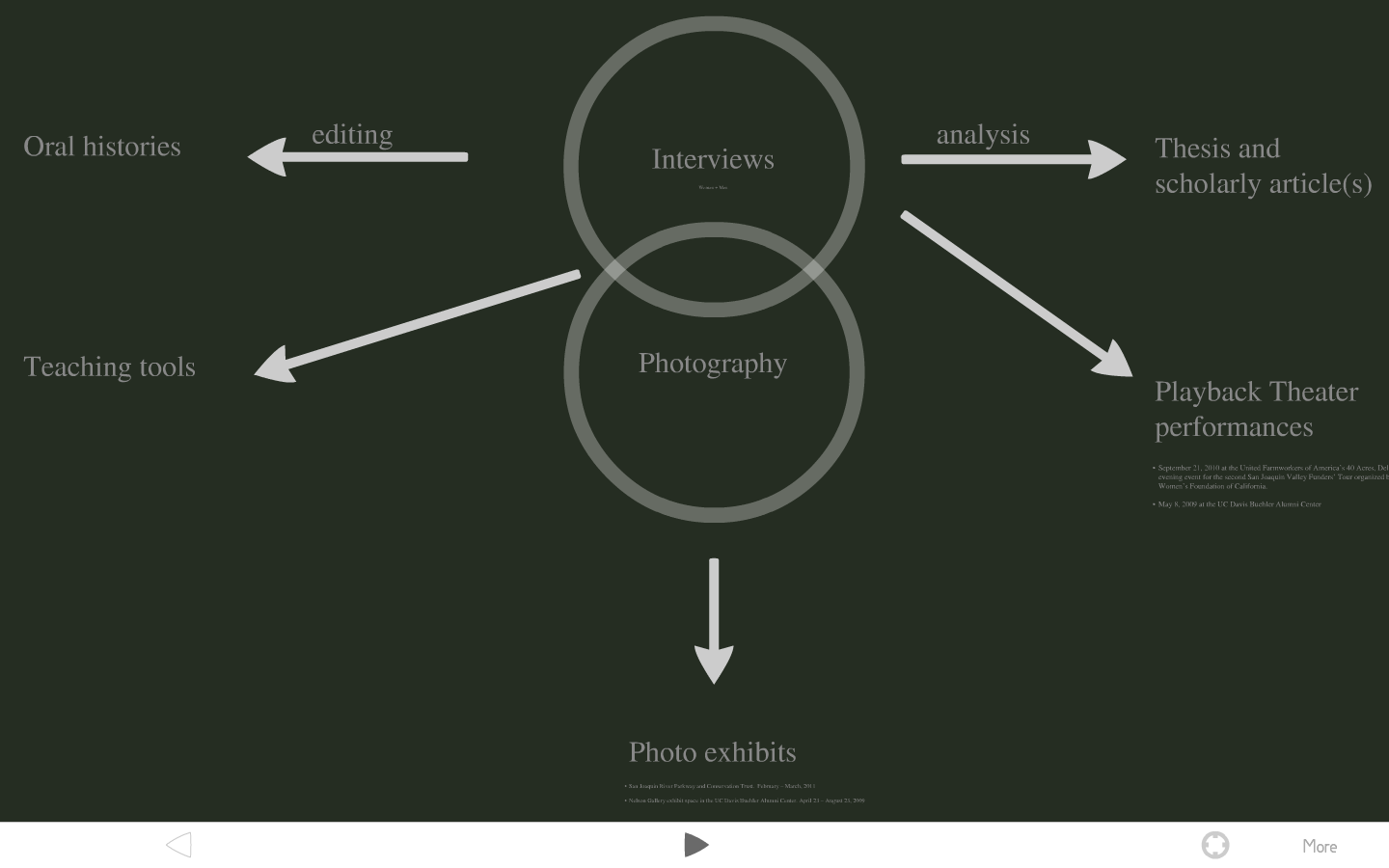
Yesterday one of the excellent tech masters at UC Davis uploaded the most recent addition to the 25 Stories from the Central Valley website: Teaching tools in Spanish (click the ‘en español’ icon in the upper right corner if the link pulls up the English version).  The tools were designed to help college-level teachers introduce basic environmental justice concepts in the classroom, but I imagine some of them could be adapted to work in other settings as well.  Three of the tools depend on English-language documents and data available online, but I decided to include them also in the hopes that others might know of Spanish-language equivalents to use.  Enjoy!

Thank you to Mateo and Roy at Berkeley Interpreting, Transcription and Translation Services for doing the translation, to Silver Cruz for updating the website, to Ed Reed at the UC Davis John Muir Institute of the Environment for getting it online, and to the UC Humanities Research Institute for paying for it!

Teaching research methods – lab curriculum

With the click of a button I’ve just uploaded all of my students’ final grades and am officially done teaching for the 2010-2011 school year!  The class I just wrapped up was my department’s undergraduate research methods class, and I’ve posted what I’ve been doing with them below for others who teach similar classes.  You’ll find a basic overview of everything I did, some online resources, and some things I wish I had done.

I’ve worked as a teaching assistant for this class twice now, and it is the class I’ve enjoyed the most so far.  By the end of the class the students have picked a research question to answer, found out what work has already been done on it and modified their question accordingly to make it improve on what has already been done, written a basic literature review, chosen research methods to answer their question, designed their research tools (survey, interview questions, etc), pre-tested and modified their research tools, and speculated on where the research might take them if they were to actually pursue the rest of it.

It’s a difficult task but some of the students get really excited about their projects, and learn a lot about scholarship in the process.  The “Big Assignments” listed below were assigned by the professor leading the class, Gabby Sandoval, and appear here with my edits.  Some of the “lab assignments” listed below I adapted from the research design class I took with Katherine Masyn when I was a masters student at UC Davis.  The important thing is to help the students break down what can be an overwhelming project into manageable weekly tasks, especially during the first half of the class as they are getting started with their projects.

The lab plan below was designed around a teaching workload that involved students going to lecture twice a week with the professor, and then attending a 2 hour lab once a week with me.  I was responsible for two labs of twenty students each.  Students each sat at their own computer, enabling me to combine lectures, group-work, and time for students to work on their projects individually while I moved around the room to consult with them.  During individual work time, I made an effort to check in with each student instead of only those that sought my help, which helped nip problems with their projects in the bud.

Week 1: No Lab

Week 2 Lab

  1. Students bring first draft of their research question to lab
  2. Mini-lecture: Research methods are cool!
  3. Mini-lecture: What is the difference between a research proposal and a term paper?
  4. Go over handout: Common Problems With Research Questions and How to Fix Them
  5. Peer review of draft research questions
  6. Introduce Lab Assignment 1: 5 new and improved versions of their research question
  7. Individual and partner work on Lab Assignment 1
  8. Turn in first draft of research question and peer-review sheet

Week 3 Lab

  1. Students get back the first draft of their research question with my feedback on it
  2. Mini lecture: Operationalizing research questions
  3. Demo: Read aloud my first and final drafts of “key terms” for my thesis research, discuss significance of the changes made on my findings
  4. Demo: 2-3 students volunteer their research questions and we work on operationalizing them as a group
  5. Lab Activity: Individual and partner work to revise and operationalize research questions
  6. Mini-lecture: review literature review assignment
  7. Introduce Lab Assignments 2 and 3: find 20 sources and fill out one article summary table
  8. Hand back lab assignment 1
  9. Individual work and student-TA check-ins
  10. Students turn in lab activity and lab assignment 1

Week 4 Lab

  1. Hand back lab assignment 1 and week 3 lab activity – review operationalization
  2. Literature Review Quiz
  3. Check in on progress on lab assignments 2 and 3 – discuss common problems with finding sources
  4. Introduce Lab Assignments 4 and 5: literature review outline and more article review tables
  5. Workshop literature review outlines for 1-2 student research questions
  6. Individual work and student-TA check-ins
  7. Students turn in lab assignments 2 and 3

Week 5 Lab

  1. Mini lecture: Review Big Assignment #1 – Literature Review
  2. Guided discussion: trouble-shoot literature review problems
  3. Mini lecture: In-text citations
  4. Individual work and student-TA check-ins: Hand back and discuss lab assignments 2 and 3 while students work on literature reviews
  5. Students turn in lab assignments 4 and 5

Week 6 Lab

  1. Students hand in Big Assignment #1: Literature Review
  2. Peer review: literature review drafts
  3. Review requirements for Big Assignment #2: Methods Section
  4. Review class calendar
  5. Introduce Lab Activity: methods worksheet
  6. Introduce Lab Assignment 6: research tool
  7. Workshop methods that could be used to answer research questions for several students
  8. Groupwork: divide by method students plan to use, and discuss how they could design research to answer their question

Week 7 Lab

  1. Methods Quiz
  2. Workshop: discuss ways to pre-test the methods of several students’ research questions
  3. Mini lecture: filling out Institutional Review Board forms
  4. Mini lecture: assessing the ethical implications of your proposed research
  5. Students get back graded literature reviews
  6. Individual work and student-TA check-ins: students work on methods section

Week 8 Lab

  1. Students hand in Big Assignment #2: Methods section
  2. Mini-lecture: Pre-testing
  3. Individual work and student-TA check-ins

Week 9 Lab

  1. Review requirements for Big Assignment #3: Final Research Proposal
  2. Hand back graded methods sections and research tools
  3. Individual work and student-TA check-ins: Students work on revising literature reviews, methods sections, or research tool as needed

Week 10 Lab

  1. Students conducting surveys as their pre-test of their research tools conduct surveys in class and get feedback from the rest of the students
  2. Hand out and review Editing check-list
  3. Individual work and student-TA check-ins

Finals Week

  1. Students turn in Big Assignment #3: Final Research Proposal


Other resources for students:

To do list for next time:

  • Create a handout that shows one basic research question reformulated in many different ways.  For example, a quantitative version of the question and a qualitative version.  Versions that would require different methods to answer:  in-depth interviews, textual analysis, participant observation, survey, etc.  The students often have a hard time imagining all the different ways that their topical interest could play out in a research project, so I think seeing one question that has been developed in many different directions will give them a sense of the array of options they have.
  • Prepare some materials to teach different approaches to writing a literature review. In particular, I’m interested in helping the students explore the slightly different role of  the literature review for an applied research project as compared to a theoretical research project.
  • Create “Areas for Improvement” feedback forms.  The form lists common errors that many students need to improve on in their papers.  As I read a paper, I circle all the items that apply to that particular paper, add a few hand-written comments and then staple it on the back.  This has worked reasonably well when I’ve used it for other classes.
  • Mark up the model research proposal that I shared with the students. The proposal I shared was written by one of my students when I taught this class last year.  It seems like it was very helpful for the students to see a model written by a peer to meet the same requirements they had instead of looking at models written by established scholars for other purposes.  It was an excellent proposal, but still had some flaws and areas for improvement that confused the students since it was being held up as a model.  I think I’ll just make a few comments on it in ‘track changes’ and share that version instead in the future.  I’ll also add a few more models that I requested from my students this year, so future students get a sense of the range of research questions and methods that they can tackle.
  • In the future I’d also like to spend more time helping the students understand examples of research projects that have had real world outcomes so they can make better links between their own research ideas and the changes they would like to see in the world.

New presentation software

I know there’s a lot of Powerpoint haters out there but I’m not one of them.  I remember using it for the first time towards the end of college and being thrilled with how easy it was to show photos, and I still enjoy it as a visually rich medium today.  Yes, some powerpoint presentations are terrible, but many other kinds of presentations are terrible too.  I’ll risk following the lead of the gun lobby to say that ‘Powerpoints don’t bore, people do.’

Nonetheless, I was excited to see a different kind of software in action for the first time at a recent conference, and used it in a presentation of my own on Friday.  Prezi let’s you create one big canvas and zoom around on it to focus on different aspects of what you want to say.  Your presentation lives online so you can access it from any computer with an internet connection, and you can e-mail people a link to your presentation for them to view on their own.

That said, it seems just as easy to go wrong with Prezi as it is with Powerpoint.  The zoom effect is fast enough that you could easily get overzealous and end up with a roomful of disoriented audience-members.  The canvas-like starting point gives you more leeway to present your ideas in a non-linear fashion, but it still won’t organize them into something meaningful for you. If your presentation doesn’t have a clear organizing thread there’s nothing the software can do to help.

Check it out yourself! Clicking here will take you to the online version of what I showed on Friday.  If you have any suggestions for improvement, let me know!

Grading season

I made the mistake today of calculating the number of pages of student work I need to grade and hand back by the end of the quarter: 1,160.

I enjoy my students, and often their ideas are really interesting, but this is the time of the quarter when this magnet on my fridge feels sadly realistic:

Creating “Principles of Collaboration” documents

Activists and scholars often have a tough time working together.  One way to make it easier is by deciding the rules of the game ahead of time.  Some partnerships formalize these agreements into “Principles of Collaboration” documents.  The idea is that if everyone knows what is expected of them ahead of time, problems are less likely to come up.

I used these documents as a key part of a guest lecture I gave recently in an environmental justice class. I started out with a Daily Show clip to get the conversation rolling (see my post on the clip here).  We talked about the tensions between environmentalists and environmental justice activists, and then segued into discussing the similar tensions between environmental justice activists and scholars.

After the “problems” conversation we talked about “solutions.”  I described how I’ve navigated the scholar/activist divide in my project 25 Stories from the Central Valley (see also here).  I also described the San Joaquin Valley Cumulative Health Impacts Project. This activist-scholar partnership resulted in maps that document the many toxins that San Joaquin Valley residents are exposed to, together with demographic data on their “social vulnerability.”  I showed the students the project’s “Principles of Collaboration” documents (see here and here), and we read through a few of their specific agreements to see how they protected both the activists and the scholars.

The students were going to be working in groups on service-learning projects to support local environmental justice organizations. I wanted them to think more about collaboration by creating their own documents to guide their group-work (the professor had already worked out the details of the partnership between the students and the environmental justice organizations ahead of time).  I adapted an activity I learned from another organization for the purpose – you can download my version here.  The students interview each other about their best experiences with group work, categorize these experiences, and then turn them into a contract to guide their work together.  When I facilitated this activity for the first time in a previous job, I was paired with a high-school student for the interview.  It was great to get to reflect on things that have actually gone well in my experiences with group work, and to think about how to make them more likely to happen again.

As it turns out, we only had enough time for the students to do the interviewing part of the activity.  I was going to come back during the next class period to guide them through the rest, but got sick and had to cancel at the last minute (sorry Flora!).  So, I haven’t tested the whole activity in this particular context.  If you give it a try, let me know how it goes!

More about the San Joaquin Valley Cumulative Health Impacts Project:

More on working across the campus-community divide:

A shout-out to the teachers

I count among my friends a number of people who work with teenagers: A Spanish teacher, a librarian, a social studies teacher, etc.  I’ve worked with teenagers in the past, and sometimes I miss it. When everything goes right, there’s a kind of life-changing intensity to their learning experiences that just doesn’t seem to happen as much with older students.  But in the end I’m always glad to be working at a university instead, especially on days like today. I got to talk with every single one of my students about the research projects they are putting together – what they think is important about them, how they want to shape them, what the ideas mean to them. I love seeing them so engaged.

Of course, teaching isn’t always fun.  Laughing at ourselves and the circumstances we sometimes find ourselves in is a great coping technique!  If you’re a teacher, I hope these videos give you a laugh and a bit of energy to keep up the good work.  If you’re not, give a teacher you know a hug.

1. Cribs: Teacher Edition (The Daily Show)

2. Tom Cruise on Teaching Composition

Environmental justice syllabus collection

I think I’m the only person I know who collects syllabi for fun.  It’s not so different from the post-card collection I had as a kid, but in place of funny pictures of animals, this collection features long lists of reading.  What’s the appeal?  Well, for anyone who loves teaching, getting to see someone’s syllabus is like seeing a blue-print for a class without having to actually take it.  What better way to get lots of ideas for how to put a class together than to graze widely on the available syllabi?

This, at least, is how I see it.  Hopefully some of you do too and will appreciate my nascent public syllabus collection. While my private collection is larger (pardon my boasting), these are syllabi that I’ve asked for and received permission to share here.  I’ll start with some of my environmental justice collection and throw in a few other environmental classes for good measure. The collection also has a permanent home under the “Teaching” tab on the menu at the top of this site.  Happy browsing!

Environmental justice classes:

Other environmental classes:

Advice for working with environmental justice groups

I gave a “virtual guest-lecture” this week for Liz Shapiro’s class on community-based environmental management at Duke University.  The class is part of one of the more appealing distance learning programs I’ve come across in a while.  The students are environmental professionals from various parts of the globe who are earning masters degrees in Environmental Management while continuing their careers.  Our class session had students participating from California, Hawaii, Chile, Texas, North Carolina, and who knows how many other places.

About two minutes before our time was up, someone asked for advice on how to work with environmental justice groups.  There is often tension between environmental groups and environmental justice groups, so it was an important question.  I did my best to answer it, but a question like that deserves more than 120 seconds worth of response time.  Here’s a slightly longer reply, drawn from things I’ve seen, done or heard about:

Find out about their experience with people like you. Whether you are a researcher, a planner, a scientist, an elected official, or some other kind of professional, it is likely that the environmental justice group will have had experience with someone more or less “like you” in the past.  Environmental justice groups make a point of claiming the expertise that comes from their lived experience of the issues, and don’t take well to professionals who try to talk over them or pull rank based on their professional credentials.  Learn from the successes and mistakes of these prior experiences.

Don’t hurry the getting to know you process.  Don’t approach a community group you don’t know with a project right before the grant proposal for it is due.  Take time to build strong relationships and meaningfully discuss how to collaborate before jumping into a new project.

Make time for face-time. Especially in the beginning, make an effort to meet and talk in person instead of on the phone or by e-mail.

Plan meetings that people can attend. Hold meetings on their turf rather than yours, in their language, at times of day convenient to them.  Provide child-care and food when possible.  If you are asking people to travel a long distance to attend, reimburse them the cost of getting there.

Be willing to change your plans. If you aren’t willing to actually change your plans based on their input, there’s no point in trying to work with environmental justice groups in the first place.

Don’t compete for funding. Prioritize applying for grants that the environmental justice group aren’t eligible for.  Apply for grants they are eligible for together.

Communicate, communicate, communicate. Don’t start a project and then leave them wondering what came of it. Seek input on your plans and activities as much as possible.

Don’t be afraid to get personal. Knowing the people you are partnering with personally makes it a lot more likely that you will trust each other, work well together, and overcome the inevitable bumps in the road.  Plus, it’s a lot more fun!

Don’t use, co-opt or tokenize. Successful partnerships are built on a sincere desire for collaboration, not a belief that it is something you need to do just to get the grant, the political good-will, or to look good.

The environmental justice advocates that I’ve gotten to know in my own work over the last few years have enriched my life enormously, and seem to be willing to forgive me when I make mistakes (I hope some of them will send in suggestions to improve this list!).  I wish you luck in your own endeavors!

Answering the “What can we do about it?” question

Last week I gave a talk to a student-taught class at UC Berkeley studying the Central Valley and planning a service-learning trip there for their spring break.  I was excited to speak with them not just because of the content matter but also because their class is run through the Democratic Education at Cal program (DeCal).  I taught several DeCal classes when I was an undergrad at UC Berkeley and fell in love with college teaching, which directly led to me being in a PhD program now.

I remember being frustrated as an undergrad that so much of my education was focused on learning about social problems and so little was focused on learning how to fix them. Knowing that I was addressing an action-oriented class, I tried to plan my talk last week accordingly.  Still, the shoe was on the other foot when I gave my own somewhat tongue-tied response to the inevitable “What can we do about it?” question at the end of my talk.  I did a little better than the generic “get involved” or “call your senator” response, but not by much. Here’s what I wish I had said instead:

Connect with organizations already working to solve the problem. You can’t solve complex social problems single-handedly.  Working in groups is almost always a better way to go, especially when you are new to a particular issue.  Find out what work is already being done before trying to launch your own campaign or project.

Learn how the political process works. I attended the Labor Summer program at UC Berkeley, which any UC student can apply to.  I’ve also heard good things about the Movement Activist Apprenticeship Program (for people of color) and the Women’s Policy Institute (for women already actively engaged in social change work).

Plan for the long haul. Social change doesn’t happen quickly, so find ways to sustain your engagement throughout your life.  This might mean training yourself for a career that makes a difference in the issues you care about.  It might mean finding a meaningful volunteer opportunity that you can do regularly with friends.  It might mean researching and making artsy voter guides for elections with friends.  It definitely means making the work as much fun as possible!

Keep the faith. I think of working for a better future in ways that I imagine religious people think about God.  Sometimes you can’t prove that your work makes a difference, but it is important to keep doing it anyway.

The Daily Show on race and the environment

My friend Bernie Zaleha shared this recent Daily Show clip with me on race and the environment in Turkey Creek, Mississippi.  Bernie is a fellow grad student here at UCSC, a former defense lawyer for Earth First!, and a former member of the national board of directors of the Sierra Club.  You can see some of his work here and here.  I love getting his insider’s take on how the big national environmental groups work, the pro’s and con’s of democratically run organizations like the Sierra Club, and insight into the history of radical environmentalism.

Bernie and I disagree on the Daily Show clip.  He sees it as an offensive attack on environmentalism in general, and in particular those doing the important and difficult work of protecting animals and their habitat.  I see it as a hilarious depiction of how wrong things can go between mainstream environmentalists and communities of color.

Either way, the clip would make a great discussion piece in class (see here for other ideas on how to teach environmental justice themes). I would use it after an introduction to ‘framing’ in social movements and the media, or in contrast to this clip (also courtesy of Bernie) that depicts the same community from a different vantage point.  Here are a few potential discussion questions:

  1. How does Wyatt Cenac frame the problems in Turkey Creek?  How does he frame the Audubon Society?
  2. How do the residents feel about the Audubon Society’s involvement in their town? Do they all feel the same way?
  3. Can you think of any other examples of tensions between people of color and the environment?
  4. Can you think of any examples of times when people of color and environmental groups have worked together on common goals?
  5. What is the value of a people-centered approach to the environment?  What is the value of a nature-centered approach to the environment?  How can the two approaches be linked?

ps.  The “Bird Like Me” section of the clip is a reference to this book from the 1960’s.