The view from faculty seating – HU Commencement with President Obama

Last Saturday Howard University hosted its 148th graduation ceremony. I donned my (borrowed) academic robes to celebrate our graduates and hear President Obama, our commencement speaker. I’ve shared my snapshots below to convey what it was like to attend and participate. They show: workers setting up for graduation during the last week of the semester, getting through security and onto campus on the day of the ceremony, faculty waiting for the event to begin and then processing into the the yard together, President Obama being “hooded” while he receives his honorary Ph.D., and the commencement ceremony. The last photo is of Sociology graduate Diamond Crumby showing off her awesome cap. Congratulations Diamond and the Howard class of 2016!

This slideshow requires JavaScript.

For the full text of President Obama’s commencement address, click here. For video, click here. And for summary and analysis, try the following:

Classes are over now, but next year I plan to show the President’s commencement speech toward the end of my Introduction to Sociology class. I’ll ask the students to analyze it according to sociological concepts we’ve been learning (structure, agency, social stratification, intersectionality, theories of change, American individualism, etc.). Then I’ll have them chew on a few of the wide array of responses to his speech listed above. I like doing these sorts of activities to underscore how the concepts we are learning in the classroom get used in the political world, even if they are not always referenced by the same names. If any of you do something similar with the speech, let me know how it goes. I won’t be teaching Intro to Sociology again until next spring, so there’s plenty of time to build on your experience.

Film Screening and Discussion

This Thursday I’m hosting a screening of Come Hell or High Water: The Battle for Turkey Creek at Howard University. The event is open to the community so please join us if you live in the area!

Here’s the film description:  “Come Hell or High Water: The Battle for Turkey Creek  follows the painful but inspiring journey of Derrick Evans, a Boston teacher who moves home to coastal Mississippi when the graves of his ancestors are bulldozed to make way for the sprawling city of Gulfport. Over the course of a decade, Derrick and his neighbors stand up to powerful corporate interests and politicians and face Hurricane Katrina and the BP oil disaster in their struggle for self-determination and environmental justice.”

After the screening, the following speakers will help us discuss the film:

  • Leslie Fields: Director of the Environmental Justice Program, Sierra Club
  • Brentin Mock: Staff writer, The City Lab
  • Terri Adams-Fuller: Department of Sociology and Anthropology, NOAA Center for Atmospheric Sciences, Associate Dean of College of Arts and Sciences, Howard University.

The screening is timed to honor Earth Day (the next day), and also to promote Howard’s new Environmental Studies undergraduate major, which begins in the fall of 2016. Please join us!

When: Thursday April 21st, 6-8pm

Where: Screening Room West, CB Powell Building, School of Communications, Howard University

Co-sponsors: Department of Sociology and Anthropology, NOAA Center for Atmospheric Sciences, School of Communications, Environmental Studies Program


Valentine’s Day and Fossil Fuels

If you’ve ever been to a workshop on how to write an op-ed, you’ll know that the leaders spend a lot of time talking about the need for your piece to have a “hook.” This usually means finding a way to link what you want to say to some kind of timely news event. Most of these are fairly straightforward. On Mother’s Day, you publish your op-ed about the need for state-sponsored maternity leave. On Valentine’s Day, you write about worker abuses and pesticide poisoning in the international cut-flower industry. Or, for another Valentine’s Day idea, you write about fossil fuels.

Wait, what? How do fossil fuels go together with Valentine’s Day? Well, watch “Breaking Up With Fossil Fuels is Hard to Do” for an example of a masterful, if somewhat unexpected, media “hook.”


Then, use it in your classrooms!

  • For media studies classes, use it as an example of a media “hook,” as described above. Or use it after showing this video first. Then use both videos to analyze framing, strategic political communication, and how political actors respond to the messages of their opponents.
  • For environmental studies, social movements, or politics classes, use the video above and this video as a way to get students interested in the politics of climate change. Both videos tell simplified, politicized stories. What truth is there in both videos? What are the the different plans that already exist for lowering our use of fossil fuels? What political forces oppose these plans? How likely are the plans to succeed in the contemporary political moment? What would it take for them to succeed?
  • For gender classes, watch the first video and ask students, “How is gender being used in this vide? What does it mean that the “fossil fuels” character is female? That the narrator is female? That the story is tied to Valentine’s Day and breaking up? What stereotypes about women are being used to help make the point that we shouldn’t “Break up with fossil fuels?”

Thank you to Jean Boucher and Milton Takei for sharing these videos on the environmental sociology listserve of the American Sociological Association. Happy teaching!

Teaching low-wage work with playspent.org

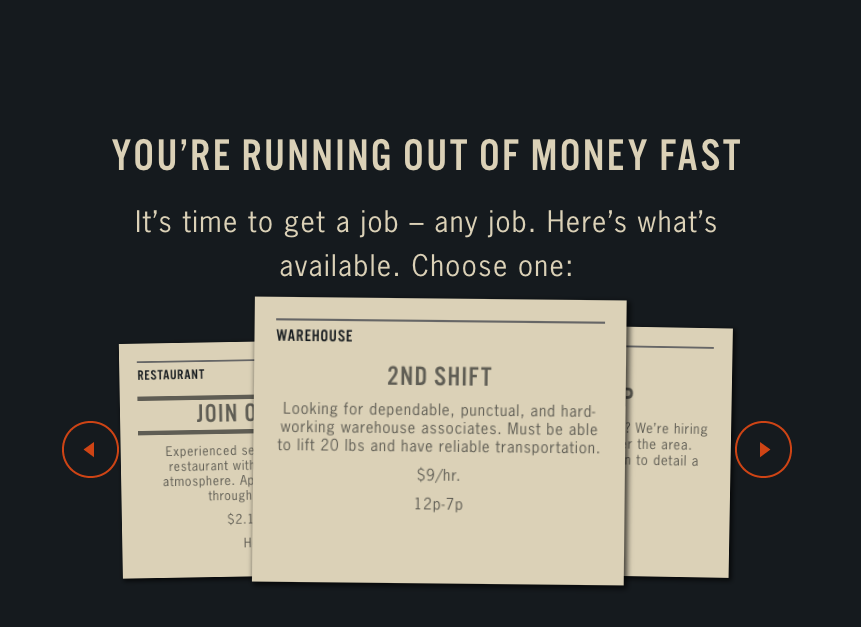
Screen Shot 2014-09-28 at 8.24.40 AMOne of the activities that went particularly well in my “Women and Work” class last winter used the website playspent.org. This website is an online “game” that challenges users to make it through the month with one of three low-wage jobs without going broke. The premise is that you are one of the many Americans who have just lost your job and your home and are down to your last $1,000 in savings. Users first select a job, then choose how far away from that job to live. At each decision-point, the consequences are made clear through short pop-up text boxes and interactive features. For example, if they choose to live farther away from their job in order to reduce rent costs, their gas expenses for commuting to the job go up. After several set-up choices are made, the month begins. Users are faced with a series of real-life scenarios to respond to as the month progresses. For example,

“Your child wants to join an after-school sports team, which requires a physical and a uniform. What do you do? Say yes ($50). Say no.”

or

“Two bills are due today. What do you want to do? Pay gas bill ($100). Pay electric bill ($125). Pay them both ($225). Borrow money from a friend.”

At other moments users have to select what items to purchase at the grocery store, get paid, get strikes on their record for taking time off from work to contest a speeding ticket in court or stay home sick. At each decision point, short pop-up text puts the decision into a national context, and the amount of money they have left to get through the rest of the month changes accordingly.

I had my students “play” the game in class on one of the days dedicated to wages. I had a regular classroom, not a computer lab, so this required students to bring their own laptops. The day before I asked for a show of hands of how many people had laptops that they could conveniently bring to our next class, and enough hands went up to proceed. On the appointed day there were enough laptops in the room for students to break into groups of two to four to play the game together. Each group played the game on their own. Many went through it several times to see how they fared while making different decisions. The discussion questions below were displayed on the overhead projector while they played. I floated around the room to see how people were progressing while they played. Students got very involved with the activity, as indicated by the difficulty I had getting them to stop and the amount of noise they made!

After I called a halt to the game and got everyone to close their laptops, we discussed the experience with the questions below. (I adapted these questions from similar ones provided by Brooke Kelley on the Sociologists for Women in Society list-serve. Thanks Brooke!)

  • How many of you made it through the month without running out of money?
  • If you made it through the month without running out of money, how much longer do you think you could have made it under the conditions of the exercise?
  • What surprised you about this exercise?
  • What parallels did you see between this exercise and the Ehrenreich reading?
  • Did you make any decisions that seemed wise at the time but which you later regretted?
  • This game isn’t gender-specific. How does it relate to our class theme of Women and Work?

The students had lots to say. Those that grew up in more financially stable households found the experience of trying on low-wage work eye-opening. Students that grew up facing similar financial difficulties seemed to find the experience validating, and shared further examples with the rest of the class. All in all, this is an activity I would do again.

••••••••••••••••••••••••••••••••••••••••••••••••••••••••••••••••••••••••••••••••••••••••••••••

This activity was paired with the following readings:

Kessler-Harris, Alice. 1990. A Woman’s Wage: Historical Meanings and Social Consequences. Lexington, KY: The University Press of Kentucky.

  • “The Wage Conceived”

Sacks, N. E. and C. Marrone. 2004. Gender and Work in Today’s World: A Reader. Cambridge: Westview Press.

  • Ehrenreich: “Nickel and Dimed: Selling in Minnesota”

On Becoming a Public Sociologist: Amplifying Women’s Voices in the Quest for Environmental Justice

60853_9781452242026I received my free copy of the recently published Sociologists in Action on Inequalities: Race, Class and Gender in the mail this week, and turned immediately to the short essay I contributed. My piece, “On Becoming a Public Sociologist: Amplifying Women’s Voices in the Quest for Environmental Justice” describes my process of becoming a public sociologist through the Voices from the Valley multi-media project on environmental justice activism in California’s agricultural San Joaquin Valley. The chapter is meant to show undergrads some of where sociology might take them. It was a fun project, and I’m looking forward to reading the other contributions in the book.


Here’s the full citation for my piece:

  • Perkins, Tracy. 2015. “On Becoming a Public Sociologist: Amplifying Women’s Voices in the Quest for Environmental Justice.” Pp. 88-92 in Sociologists in Action on Inequalities: Race, Class and Gender edited by S. K. White, J. M. White and K. O. Korgen. Los Angeles, CA: SAGE Publications.


And here’s a citation to the scholarly article that grew out of the same set of interviews that formed the basis of Voices from the Valley:

  • Perkins, Tracy. 2012. “Women’s Pathways Into Activism: Rethinking the Women’s Environmental Justice Narrative in California’s San Joaquin Valley.” Organization & Environment, 25(1):76-94.


Teaching “Women and Work” through Music Videos

When I taught “Women and Work” this winter, I had a great time experimenting with regular use of music videos. I played one just before class as students were coming in each day. I selected some of the songs myself (with help from the Sociologists for Women in Society listserve – thanks!), and others were suggested by students as part of an extra credit assignment (see more on the logic of incorporating student-generated content into the classroom in my post on the subject here). After the song finished, the person who proposed using it said a few words about why s/he chose it. Then, we might have a brief class discussion about the song and/or refer back to it for more analysis later in the class. Some of the songs expressed feminist ideals, some the opposite of that, and many were in ambiguous middle ground.

I found that playing songs as students are coming in had a number of benefits. First, it made it easier to start class on time with little disruption from late or chatty students. As they arrive they focus on watching the video and by the time  it ends they are quiet and ready to start class. Also, for the first half of the quarter or so, students also seemed to be arriving earlier than usual so as not to miss the song. Second, it gave us a fun way to expand the reach of our reading beyond the classroom and out into the pop culture in which they are immersed in day-to-day life.

See the complete syllabus, including the extra-credit assignment, here.

Here’s what we listened to, listed with my reading assignments so you can see how the songs relate to the class content.

UNIT 1: INTRODUCTION

January 7th                        

  • SONG: 9 to 5 by Dolly Parton
  • Corbett, Christianne & Catherine Hill. 2012. “Graduating to a Pay Gap: The Earnings of Women and Men One Year After College Graduation.” Washington, D.C.: AAUW.

January 9th               

  • SONG: Gonna Be an Engineer by Peggy Seeger
  • Amott, Teresa and Julie Matthaei. 2001. “Race, Class, Gender, and Women’s Works.” Pp. 234-242 in Race, Class, and Gender: An Anthology, 4th ed., edited by M. L. Andersen and P. H. Collins. Belmont, CA: Wadsworth/Thomson Learning.
  • Padavic, Irene & Barbara Reskin. 2002. Women and Men at Work. Thousand Oaks, CA: Pine Forge Press. Ch. 3: “An Overview of Sex Inequality at Work”

UNIT 2: KEY CONCEPTS

January 14th                     Progress and Virtue

  • SONG: If You See(k) Amy by Brittany Spears
  • Faludi, Susan. 1991. Backlash: The Undeclared War Against American Women. New York: Crown Publishers.  Ch. 3: Backlashes Then and Now.
  • Boryczka, Jocelyn M. 2012. Suspect Citizens: Women, Virtue and Vice in Backlash Politics. Philadelphia, PA: Temple University Press. Introduction: Moral Guardians but Suspect Citizens: Women, Virtue and Vice in the Western Political Imaginary

January 16th                     Wages and Work

  • SONG: She Works Hard for the Money by Donna Summers
  • Kessler-Harris, Alice. 2001. “The Wage Conceived: Value and Need as Measures of a Woman’s Worth.” Pp. 239-252 in Feminist Frontiers, 5th ed., edited by L. Richardson, V. Taylor and N. Whittier. New York: McGraw Hill.
  • Sacks, N. E. and C. Marrone. 2004. Gender and Work in Today’s World: A Reader. Cambridge: Westview Press. Ehrenreich: “Nickel and Dimed: Selling in Minnesota”

January 21st                     Gendered Organizations

  • ADVERTISEMENT: Virgin Atlantic – 25 Years, Still Red Hot (thanks Meeno Kohli!)
  • Acker, Joan. 1990. “Hierarchies, Jobs, Bodies: A Theory of Gendered Organizations,” Gender & Society 4(2):139-158.
  • Schilt, Kristen. 2006. “Just One of the Guys? How Transmen Make Gender Visible at Work.” Gender & Society 20(4):465-490.

January 23rd                     Structure and Choice

  • TRAILER: The Wolf of Wall Street
  • England, Paula. 2010. “The Gender Revolution: Uneven and Stalled.” Gender & Society 24:149-166.
  • Reskin, Barbara F., & Michelle L. Maroto. 2011. “What Trends? Whose Choices?: Comment on England.” Gender & Society 25:81-87.

UNIT 3: WOMEN’S WORK THROUGHOUT US HISTORY

January 28th                     Historical Overview

  • SONG: Rosie the Riveter by The Four Vagabonds
  • Coleman, Margaret S. 2000. “Undercounted and Underpaid Heroines: The Path to Equal Opportunity in Employment During the Twentieth Century.” WorkingUSA 3(5):37-65.
  • Padavic, Irene & Barbara Reskin. 2002. Women and Men at Work. Thousand Oaks, CA: Pine Forge Press. Ch. 2: Gendered Work in Time and Place

January 30th                     Racialized Experiences over Time

  • SONG: Strange Fruit by Billy Holiday
  • Ammott, Teresa & Julie Matthaei. 1996. Race, Gender and Work: A Multicultural Economic History of Women in the United States. Boston, MA: South End Press. “Climbing Gold Mountain: Asian American Women” and “We Specialize in the Wholly Impossible: African-American Women”

UNIT 4: THE DAILY EXPERIENCE OF WORK

February 4th                      Race, Class and Gender at Work

  • SONG: El Picket Sign by El Teatro Campesino (on the Rolas de Aztlan: Songs of the Chicano Movement cd)
  • García-Lopez, Gladys & Denise A. Segura. 2008. “’They are testing you all the time’: Negotiating Dual Femininities among Chicana Attorneys.” Feminist Studies 34(1/2):229-258.
  • Castaneda, Xochitl & Patricia Zavella. 2003. “Changing Constructions of Sexuality and Risk: Migrant Mexican Women Farmworkers in California.” The Journal of Latin American Anthropology 8(2):126-151.

February 6th                                  Sexualized Workplaces

  • SONG: I’m ‘n Luv Wit A Stripper by T-Pain
  • Jefreys, Sheila. 2009. Keeping Women Down and Out: The Strip Club Boom and the Reinforcement of Male Dominance. Signs 34(1):151-173.
  • Zinn, Maxin Baca, Pierette Hondagneu-Sotelo and Michael A. Messner, eds. 2011. Gender Through the Prism of Difference. New York: Oxford University Press. Patti A. Guiffre and Christine L. Williams: “Boundary Lines: Labeling Sexual Harassment in Restaurants”

February 11th                                  Emotional Labor

  • SONG: Run the World (Girls) by Beyoncé
  • Wharton, Amy S. 2009. “The Sociology of Emotional Labor.” Annual Review of Sociology. 35:147-165.
  • Lois: “Peaks and Valleys: The Gendered Emotional Culture of Rescue Workers”

UNIT 5: FAMILY LIFE AND WORK

February 13th                                  Parenting and Work

February 18th                                  Outsourcing Family Work

  • SONG: Sadie’s Servant Room Blues by Hattie Burleson
  • Duffy, Mignon. 2007. “Doing the Dirty Work: Gender, Race, and Reproductive Labor in Historical Perspective.” Gender and Society 21:313-336.
  • Sacks, N. E. and C. Marrone. 2004. Gender and Work in Today’s World: A Reader. Cambridge: Westview Press. Hondagneu-Sotelo: “Domestica: Maid in L.A.”

UNIT 6:  WOMEN MAKING CHANGE 

February 20th                                  Women and Activism

  • SONG: Girls Lie Too by Terri Clark
  • Wallace, Aubrey. 1993. Eco-Heroes: Twelve Tales of Environmental Victory. San Francisco, CA: Mercury House. “Mrs. Gibbs Goes to Washington.”
  • Perkins, Tracy. 2012. “Women’s Pathways Into Activism: Rethinking the Women’s Environmental Justice Narrative in California’s San Joaquin Valley.” Organization & Environment 25(1):76-94.

February 25th                                  Women and the Labor Movement

  • SONG: We Were There by Bev Grant and the Brooklyn Women’s Chorus
  • Boris, Eileen and Annelise Orleck. 2011. “Feminism and the Labor Movement: A Century of Collaboration and Conflict.” New Labor Forum 20(1):33-41.

March 4th                                              Case Study: Facebook’s Cheryl Sandberg

  • Sandberg, Cheryl. 2013. Lean In: Women, Work and the Will to Lead. New York: Alfred A. Knopf. Chapters 1-6

March 6th                                              Case Study: Facebook’s Cheryl Sandberg

UNIT 7: STUDENT-LED LEARNING 

March 11th                                              Student Presentations

March 13th                                               Student Presentations

March 19th                                              Student Presentations
Teaching “Women and Work” – Syllabus

Now that summer is here, I’m hoping to post some of the things I did in my “Women and Work” class from January – March. I had a great time with the class and tried out a bunch of new activities with my students. To get started, here’s a copy of the syllabus I created. I drew inspiration in shaping it from Rachel Bryant-Anderson, the last instructor to teach the class in my department. I also selected readings from the many syllabi kindly shared with me by the users of the Sociologists for Women in Society list-serve.

The buddy system: The best thing I learned in preschool

Another old post rescued from my “drafts” folder that stands the test of time.

***

My sister and her family used to live in Amish country in Western Pennsylvania.  When I visited I was impressed by the prosperous looking farms and the teams of horses out plowing the fields.  On one visit, my brother-in-law pointed out a nice home as we drove by it.  He told me the original house had recently burned down, tragically killing several of the family’s children in the fire.  My brother-in-law drove that road regularly and watched as the Amish community came together to rebuild the house – finishing it within a matter of weeks.

I’ve often thought it would be nice to feel the strong sense of community support that seems to be a part of some religions. But I turned down my own opportunity to join a church when I was a teenager, and am not likely to change my mind now. In my own small, secular ways I try to create other kinds of support systems.  They’re not romantic, and often involve making dates to do things with others that I might not do alone.  I definitely wouldn’t have spent last Friday afternoon working on the paper for my upcoming qualifying exam, or going to the gym after that, without having a standing date with my writing buddy and another with my gym buddy!

Every now and then I also miss the sense of shared purpose that can come from having a job that actually involves people all working on the same project.  Academics are mostly doing their own thing, and PhD students are certainly not allowed to co-author their dissertations.

Here’s some of what I’ve already tried and found helpful:

  • Weekly writing dates – in groups or pairs (just to write, not to workshop our writing)
  • Grading get-togethers – for moral support!
  • Exercise buddies – mostly gym time and walks
  • Soup exchanges – everyone makes a soup at home, divvies it up into containers, and gets together to trade soups so we can stock our freezers with a variety of yummy homemade soups! I try to do this each winter.
  • Friday lunch dates at the college cafeteria – thanks Bernie!
  • Project buddies – I finished my master’s thesis with the help of weekly phone meetings with two other friends working on their own theses, and did the early stages of work for my qualifying exam supported by regular coffee meetings with another fellow student (thanks Brandi!). I both cases we didn’t read each other’s work or talk about the content of our projects, but used the time to set goals, troubleshoot, and get moral support.
  • Brainstorming buddies – I have found that most of my academic advisors tend not to be productive people to brainstorm with. They’re much more useful at providing constructive criticism on ideas that are already fairly concrete. But concrete ideas are necessarily preceded by the messier work of making sense of fuzzy thoughts, general interests, and gut feelings, which for me needs to be done in a criticism-free environment, constructive or otherwise. Hence, one fellow student and I have periodically gotten together for brainstorming sessions related to our work. This usually involves big sheets of butcher paper, markers,  lots of post-its, and lots of encouragement. : )
  • Future projects partner – all of the ideas above can be done with people who have a wide variety of research interests. In addition, I have one friend whose research interests are very closely aligned with my own, and we have a shared google doc with a ever-expanding wish-list of future research and writing projects to do together. Now, it may be a long time before we get to any of them. I’m diving into my own intensive dissertation research, and my friend is wrapping up research for a post-doc at the same time that she begins a new teaching job. Still, having this running list gives me a place to cultivate the pleasure of dreaming up new projects; provides a sense of myself as a career academic who will get to work on a wide variety of projects over time, even though my dissertation currently seems interminable; and helps me trust that the future that will allow more collaborative work than my current status as a Ph.D. candidate.
I’ve heard of others who get together to do their house-cleaning in groups, taking turns with whose house they focus on, but I’ve never tried it. I also keep thinking it would be fun to do a monthly “cook for the freezer” day with a friend. You know what they say, many hands make light work! Or, at least, work that is more fun.

Speed-dating, Dave Chappelle, and the limitations of structuralism

Oops! Discovered this post written during the winter quarter in my “drafts” folder and am publishing it now…

***

Last week in discussion section for Contemporary Sociological Theory I covered Harold GarfinkelErving Goffman, and the limitations of structuralism.

To review Garfinkel and Goffman, I played the speed-dating video below (suggested by one of my students), and had the students analyze it in small groups with this worksheet.

http://www.youtube.com/watch?v=Y584fdQldoI

In a nutshell, we discussed how the video provides a good example of the unstated rules of interaction described by Garfinkel and Goffman (who were lumped together with the French Structuralists by the course instructor, Andy Szasz). Both people clearly come to the interaction with shared expectations for what happens on a speed-date, and successfully managed taking turns in conversation, flirting, and the other sorts of things meant to happen in this particular situational template.

Then, we watched the following Dave Chappelle video, “When Keeping it Real Goes Wrong” (the office scene with Vernon Franklin – also suggested by a student):

http://www.comedycentral.com/video-clips/t0brk3/chappelle-s-show-when-keeping-it-real-goes-wrong—vernon-franklin

Here the students were able to see the consequences of breaking social rules of interaction (Dave Chappelle’s character gets fired after a workplace outburst), and also discuss the limitations of the structuralist paradigm.  To help them with this latter task, I asked the following kinds of questions as I visited their small groups:

  • Does it seem like everyone in the group came to the meeting with shared expectations about what would happen there?
  • Does “give me some skin” seem to mean the same thing to Dave Chappelle’s character as it does to his mentor?
  • What emotion does Goffman tell us that people usually feel after they break social rules or lose face? Does Dave Chappelle’s character appear to be feeling this emotion?  What does he appear to be feeling?  Why?
  • Is there value in breaking with expected rules of social interaction?

Link roundup: Resources for teaching environmental justice

I’ve come across a variety of intriguing online resources in past months that I keep meaning to write-up into a variety of teaching tools. But time is short so instead I’m posting them all here, with a few short ideas on how they might be used in the classroom. Happy teaching!

Race and the outdoors

  • Stuff white people like: camping A tongue-in-cheek send-up of camping, camping culture, and the disproportionate participation of white people in camping. Could be a great way to stimulate classroom conversation about outdoor activities and race. I could see reading the post aloud and asking the following kinds of questions to get the conversation rolling: How many of you like camping?  How many of you don’t? Does this post ring true to your experience of camping or not camping? Does this post seem like an accurate representation of camping? Does this post seem like an accurate representation of who camps? Why do you think white people are the dominant participants in so many recreational activities in the outdoors?
  • Diversity and the outdoors – google hangout with Allison Chin (Sierra Club), Audrey Peterman (Legacy On the Land), Javier Sierra (Sierra Club en Español), Juan Martinez (Children and Nature Network), Rue Mapp (Outdoor Afro) and Rusty White (surfer). People of color outdoor-leaders discuss how they got interested in the outdoors and how to get more people to join them. This video would be a good follow-up to the “Stuff white people like” blog post described above because it contradicts it in some ways. You could ask students to consider how the leaders featured in the google hangout might respond to the “stuff white people like” blog post.  Would they agree or disagree with its content?
  • America’s forgotten black cowboys This article could help students question racialized narratives of the American West, as well as to consider the historical experiences of people of color in the American outdoors.

Race, Nation, and Agriculture: The “God Made a Farmer” Videos 

I could imagine showing the first video without any introduction and asking the following questions at the end of it:  Did you notice anything odd about this video?  Was anything missing? If the students can’t think of anything, show the second video and ask them the question again. The point would be to launch into a discussion of the video’s startling use of white people to represent farming in America, in spite of the fact that the vast majority of people working in this industry are Latino. This could be a fruitful jumping off point for discussion about framing, narrative, representation, race, the history of farming in America, or any number of other juicy topics. Be sure to discuss what the difference between a “farmer” and a “farmworker” is. Child labor could make for an interesting and relevant topic for a follow-up conversation too.

Data

Other data sources. See this activity for ideas on how they could be used.

Multimedia 

I’m not sure how I would use these in the college classroom, but wanted to post them here for future reference.