Participatory action research for environmental justice

The UC Davis Center for Regional Change launched their newest report yesterday: Land of Risk/ Land of Opportunity: Cumulative Environmental Vulnerability in California’s San Joaquin Valley. The report documents how exposure to environmental pollution tends to go hand and hand with social vulnerability, creates maps that visually depict this relationship, and provides several case-studies.

This report was created by the authors with partners from the San Joaquin Valley through the San Joaquin Valley Cumulative Health Impacts Project.  I attended one or two of the group’s earliest meetings several years ago and have tracked their progress through conversations with the lead author (my former advisor Jonathan London) and the environmental justice advocates that are part of my own research.  I also donated a few of my photographs for use in the final report.

When I give guest-lectures on divisions between campus-community divides, I often use this project as an example of ways that scholars and activists can work together productively.  In particular, I find it helpful to show students the detailed agreements that the group worked out ahead of time to guide their collaboration.  Because the work of scholars and activists are judged in different ways, these kinds of guidelines can go a long way toward anticipating and resolving the tensions that often come up.  You can see their agreements (shared with the lead author’s permission), in this post.

Introducing Ruth Martinez

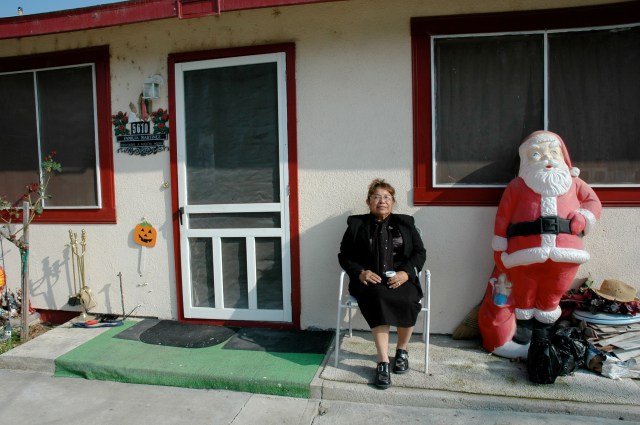
Ruth Martinez is a community organizer who lives in the small town of Ducor in the San Joaquin Valley. I interviewed her several years ago for my Master’s thesis and wrote the story below based on what she told me about how she came to be an activist. I stopped by her house this morning to get her permission to share her story.  Ruth was keeping off her feet after having broken her foot on a recent United Farm Workers of America (UFW) march to Sacramento.  Besides her involvement with the UFW, Ruth is also active with the Center on Race Poverty and the Environment, the Community Water Center, and the Asociación de Gente Unida por el Agua

Ruth’s story begins with her marriage at 15.  Her husband was a farm worker who was active in the UFW.  She joined him on the marches and political campaigns that were connected with his work.  Ruth had always wanted to be a nurse, but from a young age she had epileptic seizures.  As she told me, “César Chávez never said, ‘No, you can’t.’  That’s why his slogan was ‘Si, se puede,’ because yes, you can.”  Ruth’s husband took her to a UFW meeting at 40 Acres in Delano, which had a clinic for farm workers at that time.  Ruth saw the nurses and said, “Oh, I always wanted to be a nurse.”  César heard her and said “Well, why aren’t you?” Ruth said, “Because I can’t.  I get seizures and everybody’s told me I’d never be able to be a nurse because of my seizures.”  César said, “You can be anything you want to,” and helped her go to nurse’s aide training.  Ruth worked as a nurse’s aide until she finished college and received her nursing degree.  She was a nurse for 30 years before retiring.  After one month of retirement she became tired of not doing anything and went back to work.  Now she works at a unionized (UFW) rose farm, taking out the thorns that get stuck in the farm workers hands, face and eyes and seeing to other health problems as well.

During her years as a nurse Ruth would go on the UFW marches to take care of people who got sick or who had too many blisters on their feet from marching.  She remembers one march from Delano to Sacramento in particular.  She got upset because the organizers put her in a van to tend to the sick but she wanted to be out marching.  She describes the impact of starting with about 20 people in Delano and ending in Sacramento with thousands.  She remembers how the Teamsters and just about everyone else worked against them on that march, and how different it was from a march from Merced to Sacramento that they did around 1990 or 2000.  This time the Teamster’s lent them their hall in Sacramento to sleep in; the police provided an escort; and truckers stopped to get them sodas and water to drink as they marched.

Ruth and her family moved from a home surrounded by a grape orchard to the small town where she still lives.  Her family, and many of the neighbors, had “self-help” houses built for them because of their low-income status.  Early on there were problems with the water supply in town, and residents were told not to flush their toilets at certain hours, and to only take showers at other hours.  Ruth felt this wasn’t right and asked her sister, who worked at a regional non-profit, to send a legal assistant over to help resolve the problem.  Ruth began collecting signatures in town to replace the private water company with a community service district that the whole town would co-own.  The campaign was successful and very personally meaningful to Ruth, who years later ended up on the water board for the town.

For a time the water system worked well and provided them with clean water, albeit sometimes at low pressure.  But later the town began having problems with their water again.  This time it smelled terrible and in many houses came out looking brown and muddy.  Ruth had already been introduced to the environmental justice organization nearby, and began working on the water problem with one of their organizers.  They formed a committee for people in the San Joaquin Valley with water problems, and went to Sacramento, Fresno and San Francisco to attend various water board meetings in an attempt to resolve their problem.  Ruth faced strong opposition from her local board when she brought bottles of the smelly brown water collected from neighbors’ homes as examples of what they had to live with.  Ruth and the other neighbors still had to pay for the poor-quality water that they were receiving. She used bottled water to cook with but bathed in the tap water, although she used bottled water to wash her hair so it would not retain the sewage smell of the tap water.  Ruth’s grandchildren would come to visit and Ruth would bathe them, but then her daughter would find rashes on the children, which they decided must have been caused by the water.  During this time several of Ruth’s old UFW friends joined the nearby environmental justice group, and began inviting her to meetings that they were organizing on pesticide buffer zones and the possibility of receiving a grant to put in sewage lines in her town.

Ruth’s father died when she was young.  Her mother spoke little English, and Ruth credits her with very little influence in terms of her own work as an activist. Somehow she and her sister ended up being the only ones in their family who were “a little pushy”, and tried to fix things when they thought something was wrong.  She thinks the female movement must have had a lot to do with it.

Toward the end of our interview I asked Ruth if she has any children, and she told me that she has four.  Ruth’s first child is the healthiest, and she was born before Ruth and her husband moved to a home in the middle of a grape orchard.  Of the second two children born on the ranch, one was born with only one kidney* and one has high blood pressure and diabetes.  The fourth child has a serious case of asthma.  Ruth attributes the child born with one kidney and the other child’s asthma to the pesticides to which they were exposed.

Now, at 65 or a little older, Ruth is still working as a nurse.  She works on local and regional water issues, and continues to support political campaigns that are backed by the UFW.  Most recently, she went to Los Angeles to support Antonio Villaraigosa’s campaign to be the first Latino mayor.  She walked the streets and talked to the voters on election day.  She also works with Catholic Charities registering new people to become citizens.  Her husband died 12 years ago of a heart attack and diabetes.

* Ruth’s daughter passed away in November of 2010.
Spanish language teaching tools for environmental justice

Yesterday one of the excellent tech masters at UC Davis uploaded the most recent addition to the 25 Stories from the Central Valley website: Teaching tools in Spanish (click the ‘en español’ icon in the upper right corner if the link pulls up the English version).  The tools were designed to help college-level teachers introduce basic environmental justice concepts in the classroom, but I imagine some of them could be adapted to work in other settings as well.  Three of the tools depend on English-language documents and data available online, but I decided to include them also in the hopes that others might know of Spanish-language equivalents to use.  Enjoy!

Thank you to Mateo and Roy at Berkeley Interpreting, Transcription and Translation Services for doing the translation, to Silver Cruz for updating the website, to Ed Reed at the UC Davis John Muir Institute of the Environment for getting it online, and to the UC Humanities Research Institute for paying for it!

Californians without clean drinking water – slideshow

This slideshow requires JavaScript.

When I talk to people about my research in the San Joaquin Valley, one of the things they are surprised to learn is that many small communities there don’t have safe drinking water.  It’s the kind of problem people associate with third world countries, not the USA.  Nonetheless, pollutants from pesticides, fertilizers, mega-dairy sewage and old pipes as well as naturally occurring arsenic get into the drinking water in some Valley towns.  Sometimes what comes out of the tap is brown and smells like sewage.

In our interviews, some women described the notices they get in the mail that tell them their drinking water is contaminated, but is safe to keep drinking. Further down the page, however, the flyer often states that if they drink the water for many years they could be more likely to get cancer.  For women who had already been drinking the tap water in these towns for many years, these notices were frightening to say the least.  Other women described having their water systems shut down, driving long distances to purchase bottled water, or having skin problems and hair loss.

So, I’ve been pleased to see the drinking water problems in the Valley getting more attention recently.  Yesterday California Watch reported on the “Human Right to Water” package of bills now in Congress.  Schwarzenegger vetoed many of them in the past, but perhaps they’ll have better luck with Gov. Brown.  Earlier this year the UN Special Rappoteur  on the Human Right to Water and Sanitation also visited the Central Valley to raise the visibility of drinking water problems.

Press

Videos
Reports

Creating “Principles of Collaboration” documents

Activists and scholars often have a tough time working together.  One way to make it easier is by deciding the rules of the game ahead of time.  Some partnerships formalize these agreements into “Principles of Collaboration” documents.  The idea is that if everyone knows what is expected of them ahead of time, problems are less likely to come up.

I used these documents as a key part of a guest lecture I gave recently in an environmental justice class. I started out with a Daily Show clip to get the conversation rolling (see my post on the clip here).  We talked about the tensions between environmentalists and environmental justice activists, and then segued into discussing the similar tensions between environmental justice activists and scholars.

After the “problems” conversation we talked about “solutions.”  I described how I’ve navigated the scholar/activist divide in my project 25 Stories from the Central Valley (see also here).  I also described the San Joaquin Valley Cumulative Health Impacts Project. This activist-scholar partnership resulted in maps that document the many toxins that San Joaquin Valley residents are exposed to, together with demographic data on their “social vulnerability.”  I showed the students the project’s “Principles of Collaboration” documents (see here and here), and we read through a few of their specific agreements to see how they protected both the activists and the scholars.

The students were going to be working in groups on service-learning projects to support local environmental justice organizations. I wanted them to think more about collaboration by creating their own documents to guide their group-work (the professor had already worked out the details of the partnership between the students and the environmental justice organizations ahead of time).  I adapted an activity I learned from another organization for the purpose – you can download my version here.  The students interview each other about their best experiences with group work, categorize these experiences, and then turn them into a contract to guide their work together.  When I facilitated this activity for the first time in a previous job, I was paired with a high-school student for the interview.  It was great to get to reflect on things that have actually gone well in my experiences with group work, and to think about how to make them more likely to happen again.

As it turns out, we only had enough time for the students to do the interviewing part of the activity.  I was going to come back during the next class period to guide them through the rest, but got sick and had to cancel at the last minute (sorry Flora!).  So, I haven’t tested the whole activity in this particular context.  If you give it a try, let me know how it goes!

More about the San Joaquin Valley Cumulative Health Impacts Project:

More on working across the campus-community divide:

What do people from California have in common with people from Chiapas?

What do people from California have in common with people from Chiapas?  Read Jeff Conant’s latest article on AlterNet today to find out!  Be sure to check out the slideshow that accompanies it too – it includes some of my photos from the San Joaquin Valley.  Some of them have already been published elsewhere and some are new (like the one below).  All were chosen by the author to help readers visualize some of the toxicity problems in the San Joaquin Valley so they might better understand why some Valley residents participated in the recent lawsuit against California’s Global Warming Solutions Act.  See my other post on this topic here.

Jeff used to be my boss at the Hesperian Foundation when we worked on this book together (Spanish translation coming soon!).  He came to Hesperian after getting booted out of Mexico for, as I understand it, the crime of volunteering on small scale water distribution systems in Zapatista communities in Chiapas.  I left Hesperian to get a master’s degree at UC Davis, where I researched the Central Valley environmental justice movement.  Through the twists and turns of current events, our working lives have crossed paths again, this time through concerns about how a policy designed to slow climate change might negatively impact poor people in both California and Chiapas.

In our past life together, Jeff’s job was to write a book and mine was to get it illustrated, so providing photos for his article this week was a fun twist on an old theme.

power lines

Environmental justice syllabus collection

I think I’m the only person I know who collects syllabi for fun.  It’s not so different from the post-card collection I had as a kid, but in place of funny pictures of animals, this collection features long lists of reading.  What’s the appeal?  Well, for anyone who loves teaching, getting to see someone’s syllabus is like seeing a blue-print for a class without having to actually take it.  What better way to get lots of ideas for how to put a class together than to graze widely on the available syllabi?

This, at least, is how I see it.  Hopefully some of you do too and will appreciate my nascent public syllabus collection. While my private collection is larger (pardon my boasting), these are syllabi that I’ve asked for and received permission to share here.  I’ll start with some of my environmental justice collection and throw in a few other environmental classes for good measure. The collection also has a permanent home under the “Teaching” tab on the menu at the top of this site.  Happy browsing!

Environmental justice classes:

Other environmental classes:

Does containing climate change come at the expense of California’s most vulnerable?

Does containing climate change come at the expense of poor people and people of color in California?  According to a statewide coalition of environmental justice advocates, the answer is yes.  Therefore, they have sued the the California Air Resources Board over the way the state proposes to reduce our greenhouse gas emissions.

Environmental justice advocates were involved in the creation of the Global Warming Solutions Act, which was passed through the California legislature in 2006.  Advocates were involved in the legislative process not just to help create a solution to climate change, but also to make sure that reducing greenhouse gases at the statewide level would not increase them unfairly at local levels.  But since the Global Warming Solutions Act was passed, they argue that the plan developed by the California Air Resources Board to actually carry out the legislation has moved in a different direction.

The implementation plan proposes a number of different tools to help reduce greenhouse gas emissions in California. Although they support many of these tools, environmental justice advocates are worried about one of the biggest hitters on the list: a market-based approach to containing greenhouse gas emissions called “cap-and-trade.” As I understand it, using cap-and-trade is like giving all the polluters a deck of cards in which each card enables its bearer to emit a certain amount of pollution.  Then they can trade the cards among themselves to their satisfaction.  But in a twist to how most games work, players can also buy more pollution cards from people not part of the game at all.  For example, a California polluter could continue to pollute by paying people in Mexico to plant trees, or by paying a lumber company in Canada for the tree-planting they routinely do after a clear-cut operation.  This means business as usual, and continued high air pollution levels, for the people who live closest to polluters here in California.  Local air pollution levels could get even worse over time under cap-and-trade policies in the likely event that polluting facilities decide to expand, and make up for their increased emissions by purchasing more pollution cards, or “offsets,” from elsewhere. This would exacerbate the existing distribution of pollution, which poor people and people of color get the worst of.  On the other hand, directly regulating polluters could mean local reductions in greenhouse gas emissions AND the associated air pollutants. (My recent article mentions another way that the Global Warming Solutions Act could worsen air pollution locally, though not through the cap-and-trade policy.)

Environmental justice groups eventually sued the California Air Resources Board over the implementation plan.  The motivation for the case is based partly on the fact that there is a significant overlap between greenhouse gases, which contribute to climate change for everyone, and  air pollution, which causes health problems for the people who live closest to it. The effort by the Environmental Defense Fund to intervene in the suit on behalf of the state reveals the continuing tensions in the environmental movement about how to respond to climate change.  Should we compromise with industry to get solutions that prioritize countering global warming at the planetary level?  Or should we champion more politically challenging solutions that include the poor and people of color as immediate beneficiaries in any solution to climate change?  In this case, the Environmental Defense Fund’s petition was thrown out, and last week the environmental justice advocates won part of their case.  The judge’s decision found that the California Air Resources Board emphasized the cap-and-trade plan without adequately adhering to the law, which required the Air Resources Board to considering an array of possible solutions beyond just cap and trade, and to allow for public comment and deliberation on the various options available.

UCSC alum and lawyer Brent Newell will be visiting my university next week to give us his insider’s perspective.  His organization is one of two representing the plaintiffs in this case.  The title of his talk is “Climate Justice:  Global Climate Disruption and the Struggle for Environmental Justice.” He’ll be talking about the case above, as well as another climate justice case in Alaska.  Those of you who are local can come hear him speak at the Environmental Studies Department’s weekly seminar: April 4th, from 12:30-2:00 at the Interdisciplinary Sciences Building, room 221.

Press:

Scholarly studies:

The plaintiffs:

The lawyers:

Other:

And here’s a copy of the judge’s 35 page decision, as shared by the LA times

Playback Theater for environmental justice – slideshow

This slideshow requires JavaScript.

Over the last two years, I’ve been part of several Playback Theater performances designed to honor environmental justice advocates and share their stories.  Not as an actress, mind you, but as someone helping to bring together the actors, activists and audience so the magic can happen.

Playback Theater is a unique type of theater that asks audience members to shape the performance by sharing stories from their lives.   The director solicits personal stories from the audience, invites a volunteer up to the stage to tell their story, and asks a few follow-up questions to get more details.  The story-teller then choses one of the actors to play herself, the actors take a moment to wordlessly soak up the story, and then re-enact it on stage. It is all based on improv: nobody knows who will share what stories or how the actors will interpret them until it happens on stage.  In some cases the director will also ask for reactions to the story from the audience, and the actors briefly interpret those reactions too. When it works it is electrifying.

I can’t say what it was like for the environmental justice activists who shared their stories to see their lives retold on stage. But I know from seeing my own stories brought to life during rehearsals that having so much respect, care and attention given to your own experiences can be deeply meaningful.  And I can attest that a number of the audience members unfamiliar with the issues found the performances profoundly moving, and still carry those memories with them.

The idea for doing these shows came from my very talented friend John Chung, who some of you know as Jiwon. John and I were having dinner at a great Korean restaurant in Oakland one night while I was chewing over the usual grad student dilemma of how to do research that actually has some real impact in the world.  I had already developed the basic idea of doing oral history interviews with women environmental justice leaders from the Central Valley, which I could analyze for my academic writing and also edit into stories to help educate the public (more on this later). John suggested adding Playback Theater performances into the mix,  and I thought it was a great idea.   I had some familiarity with the technique through having seen him perform as part of the Living Arts Playback Theater Ensemble, and from having attended a workshop series on Theater of the Oppressed taught by John and other members of the Bay Area Theater of the Oppressed Lab. (Those of you familiar with popular education will be particularly interested in Theater of the Oppressed. It was developed by Augusto Boal, a Brazilian contemporary of Paulo Freire.)

The photos above were taken by Peter John Olandt and myself.  They depict three separate performances at:

Putting this slideshow together has been a lovely way for me to remember what a special experience the performances were.  I hope they give the rest of you a taste of what transpired.  Thank you again to the Kairos Theater Ensemble for making it all happen.  Their work is truly a labor of love.

Kairos Theater Ensemble:

Ben Rivers (Actor)
Dara Kaufmann-Ledonne (Actress)
Deborah French Frischer (Actress)
Jason Agar (Actor)
Veronica Haro (Actress)
John Kadyk (Musician)
Jiwon Chung (Artistic Director – contact him at jiwonchung at sksm dot edu to schedule your own performance.  Or try and get into one of his Theater of the Oppressed classes at the Graduate Theological Union in Berkeley)

Advice for working with environmental justice groups

I gave a “virtual guest-lecture” this week for Liz Shapiro’s class on community-based environmental management at Duke University.  The class is part of one of the more appealing distance learning programs I’ve come across in a while.  The students are environmental professionals from various parts of the globe who are earning masters degrees in Environmental Management while continuing their careers.  Our class session had students participating from California, Hawaii, Chile, Texas, North Carolina, and who knows how many other places.

About two minutes before our time was up, someone asked for advice on how to work with environmental justice groups.  There is often tension between environmental groups and environmental justice groups, so it was an important question.  I did my best to answer it, but a question like that deserves more than 120 seconds worth of response time.  Here’s a slightly longer reply, drawn from things I’ve seen, done or heard about:

Find out about their experience with people like you. Whether you are a researcher, a planner, a scientist, an elected official, or some other kind of professional, it is likely that the environmental justice group will have had experience with someone more or less “like you” in the past.  Environmental justice groups make a point of claiming the expertise that comes from their lived experience of the issues, and don’t take well to professionals who try to talk over them or pull rank based on their professional credentials.  Learn from the successes and mistakes of these prior experiences.

Don’t hurry the getting to know you process.  Don’t approach a community group you don’t know with a project right before the grant proposal for it is due.  Take time to build strong relationships and meaningfully discuss how to collaborate before jumping into a new project.

Make time for face-time. Especially in the beginning, make an effort to meet and talk in person instead of on the phone or by e-mail.

Plan meetings that people can attend. Hold meetings on their turf rather than yours, in their language, at times of day convenient to them.  Provide child-care and food when possible.  If you are asking people to travel a long distance to attend, reimburse them the cost of getting there.

Be willing to change your plans. If you aren’t willing to actually change your plans based on their input, there’s no point in trying to work with environmental justice groups in the first place.

Don’t compete for funding. Prioritize applying for grants that the environmental justice group aren’t eligible for.  Apply for grants they are eligible for together.

Communicate, communicate, communicate. Don’t start a project and then leave them wondering what came of it. Seek input on your plans and activities as much as possible.

Don’t be afraid to get personal. Knowing the people you are partnering with personally makes it a lot more likely that you will trust each other, work well together, and overcome the inevitable bumps in the road.  Plus, it’s a lot more fun!

Don’t use, co-opt or tokenize. Successful partnerships are built on a sincere desire for collaboration, not a belief that it is something you need to do just to get the grant, the political good-will, or to look good.

The environmental justice advocates that I’ve gotten to know in my own work over the last few years have enriched my life enormously, and seem to be willing to forgive me when I make mistakes (I hope some of them will send in suggestions to improve this list!).  I wish you luck in your own endeavors!