Answering the “What can we do about it?” question

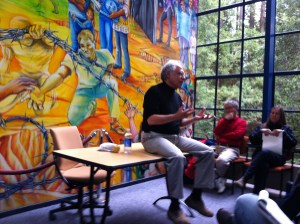
Last week I gave a talk to a student-taught class at UC Berkeley studying the Central Valley and planning a service-learning trip there for their spring break.  I was excited to speak with them not just because of the content matter but also because their class is run through the Democratic Education at Cal program (DeCal).  I taught several DeCal classes when I was an undergrad at UC Berkeley and fell in love with college teaching, which directly led to me being in a PhD program now.

I remember being frustrated as an undergrad that so much of my education was focused on learning about social problems and so little was focused on learning how to fix them. Knowing that I was addressing an action-oriented class, I tried to plan my talk last week accordingly.  Still, the shoe was on the other foot when I gave my own somewhat tongue-tied response to the inevitable “What can we do about it?” question at the end of my talk.  I did a little better than the generic “get involved” or “call your senator” response, but not by much. Here’s what I wish I had said instead:

Connect with organizations already working to solve the problem. You can’t solve complex social problems single-handedly.  Working in groups is almost always a better way to go, especially when you are new to a particular issue.  Find out what work is already being done before trying to launch your own campaign or project.

Learn how the political process works. I attended the Labor Summer program at UC Berkeley, which any UC student can apply to.  I’ve also heard good things about the Movement Activist Apprenticeship Program (for people of color) and the Women’s Policy Institute (for women already actively engaged in social change work).

Plan for the long haul. Social change doesn’t happen quickly, so find ways to sustain your engagement throughout your life.  This might mean training yourself for a career that makes a difference in the issues you care about.  It might mean finding a meaningful volunteer opportunity that you can do regularly with friends.  It might mean researching and making artsy voter guides for elections with friends.  It definitely means making the work as much fun as possible!

Keep the faith. I think of working for a better future in ways that I imagine religious people think about God.  Sometimes you can’t prove that your work makes a difference, but it is important to keep doing it anyway.

New article by yours truly!

I’ve got an article coming out today in the inaugural edition of the new UC Press journal Boom: A Journal of California.  I wrote it with one of my Master’s advisors from UC Davis, Julie Sze.  I’m excited because Boom is designed to be a cross-over publication read by scholars and the general public alike, so among other things, it looks beautiful and some of the articles are available for free online (hard-copies are also for sale in some news outlets and bookstores).  The editors also tried to make it “count” for academic contributors by putting it through the usual scholarly peer review process.  I wish this new publication every success and hope to see more like it in the future!

Our piece features a short article on environmental justice in the Central Valley, some of my photos from the 25 Stories from the Central Valley exhibit, and excerpts from my interviews with Teresa DeAnda (Earlimart), Mary Lou Mares (Kettleman City) and Debbie Reyes (Fresno).  I’ll be attending one of the launch events at the Oakland Museum tomorrow night.

Here’s the intro text:

When Californians think of the Central Valley, they often think of its problems: poverty, pesticides, disputes over the allocation of irrigation water, farmworker deaths, and, most recently, a cluster of babies born with birth defects in the small town of Kettleman City. These are some of the ways this region makes the statewide news. But the Central Valley also has a rich history of community organizing and its own stark beauty. These photographs by Tracy Perkins and the oral histories she collected to accompany them document an important aspect of life there: environmental-health problems and the diverse network of advocates who are fighting to solve them.

Practically speaking, the Central Valley is all but invisible to those who live outside it. Over the course of the twentieth century, legislators and growers turned this 500-mile-long stretch of land into one of the most intensively farmed regions in the world, watered by one of the world’s most ambitious irrigation systems. Although California leads the nation in agricultural production, many Californians have little sense of what goes on in the agricultural regions of their state. This invisibility helps to explain why California has located two of the state’s three hazardous-waste landfills and many of its prisons there, while also continuing to allow high levels of toxicity in the air and water…

Read the complete article for free on the Boom website here, or to get the full impact of the beautiful print version, download the pdf here.

Robert Gottlieb’s new book “Food Justice”

I managed to escape my office today long enough to attend a talk by Robert Gottlieb on his latest book, “Food Justice.” I haven’t read it yet, but took a look through the table of contents during the talk and came back to my office and ordered myself a copy.  Gottlieb and his coauthor Anapuma Joshi set their book apart from many of the other food-oriented books out now by addressing food’s implications for social justice from start to finish: growing the food, transporting it, serving it, eating it (not sure if they get into waste too).  Most activist groups and scholars that I know of tend to focus on just one aspect of food, for example, industrial agriculture or organic food.  This results in groups that could conceivably give each other a lot of political support remaining fairly separate instead.  I do see some signs of convergence though.  For example, the food movement, which has largely relied on market-based strategies such as organic labeling to promote their cause, is increasingly looking to policy solutions in the Farm Bill and other laws.  And some environmental justice groups in the Central Valley, which have largely relied on community organizing and policy solutions to advance their causes, are interested in exploring market-based solutions to help lead their communities out of poverty (see, for example, the Center on Race, Poverty and the Environment’s new project to help farmworkers become organic farmers).  Hopefully “Food Justice” is a sign of increased collaboration to come between these groups.

I’m also looking forward to reading the review of the book written by long-time sustainable agriculture educator Cristof Bernau in the upcoming edition of Human Ecology.

The Daily Show on race and the environment

My friend Bernie Zaleha shared this recent Daily Show clip with me on race and the environment in Turkey Creek, Mississippi.  Bernie is a fellow grad student here at UCSC, a former defense lawyer for Earth First!, and a former member of the national board of directors of the Sierra Club.  You can see some of his work here and here.  I love getting his insider’s take on how the big national environmental groups work, the pro’s and con’s of democratically run organizations like the Sierra Club, and insight into the history of radical environmentalism.

Bernie and I disagree on the Daily Show clip.  He sees it as an offensive attack on environmentalism in general, and in particular those doing the important and difficult work of protecting animals and their habitat.  I see it as a hilarious depiction of how wrong things can go between mainstream environmentalists and communities of color.

Either way, the clip would make a great discussion piece in class (see here for other ideas on how to teach environmental justice themes). I would use it after an introduction to ‘framing’ in social movements and the media, or in contrast to this clip (also courtesy of Bernie) that depicts the same community from a different vantage point.  Here are a few potential discussion questions:

  1. How does Wyatt Cenac frame the problems in Turkey Creek?  How does he frame the Audubon Society?
  2. How do the residents feel about the Audubon Society’s involvement in their town? Do they all feel the same way?
  3. Can you think of any other examples of tensions between people of color and the environment?
  4. Can you think of any examples of times when people of color and environmental groups have worked together on common goals?
  5. What is the value of a people-centered approach to the environment?  What is the value of a nature-centered approach to the environment?  How can the two approaches be linked?

ps.  The “Bird Like Me” section of the clip is a reference to this book from the 1960’s.

Photo exhibit!

This Friday opens the latest exhibit of my photos in the “25 Stories from the Central Valley” collection.  They are already online here, but there’s something extra-special about seeing them “in the flesh” too.  I dropped them off on Sunday and had a good time deciding how to group them in the space they’ll be displayed.

The exhibit is hosted by the San Joaquin River Parkway and Conservation Trust at their scenic headquarters in Fresno.  I’m excited about the show for two reasons.  First, this is the first conservation group (as opposed to environmental justice group) that I’ve had contact with in the Central Valley, and I’m happy the photos can serve as a small bridge between these two facets of environmentalism.  Second, we’ve already shown the photos on the campus where the project started, UC Davis, and this will be the first time they are shown in the region where they were actually taken.

I’ll be attending the exhibit’s reception this Friday (details here).  Hope to see you there!

New radio series on birth defect cluster in Kettleman City, CA

Capital Public Radio produced a new three-part series on the birth defect cluster in Kettleman City, listen to it here.

Kettleman City located in California’s Central Valley, a few miles away from the largest hazardous waste incinerator west of the Mississippi.  Residents defeated an attempt to add a hazardous waste incinerator to the landfill site in the early 90’s.  Nonetheless, they continue to live near a large amount of toxic waste stored by a company that has been fined for breaking the law in their storage practices.  The birth defect cluster has brought them to national attention once again, as the try to make sense of what is happening to them and find out what is causing it.

This also seems like a good opportunity to collect some of the other recent press coverage.  See other teaching resources specific to Kettleman City here, here (in adaptations sections) and here.

Kettleman City Birth Defect Cluster – Press

Radio:
Newspaper and Magazine: