What do people from California have in common with people from Chiapas?

What do people from California have in common with people from Chiapas?  Read Jeff Conant’s latest article on AlterNet today to find out!  Be sure to check out the slideshow that accompanies it too – it includes some of my photos from the San Joaquin Valley.  Some of them have already been published elsewhere and some are new (like the one below).  All were chosen by the author to help readers visualize some of the toxicity problems in the San Joaquin Valley so they might better understand why some Valley residents participated in the recent lawsuit against California’s Global Warming Solutions Act.  See my other post on this topic here.

Jeff used to be my boss at the Hesperian Foundation when we worked on this book together (Spanish translation coming soon!).  He came to Hesperian after getting booted out of Mexico for, as I understand it, the crime of volunteering on small scale water distribution systems in Zapatista communities in Chiapas.  I left Hesperian to get a master’s degree at UC Davis, where I researched the Central Valley environmental justice movement.  Through the twists and turns of current events, our working lives have crossed paths again, this time through concerns about how a policy designed to slow climate change might negatively impact poor people in both California and Chiapas.

In our past life together, Jeff’s job was to write a book and mine was to get it illustrated, so providing photos for his article this week was a fun twist on an old theme.

power lines

Environmental justice syllabus collection

I think I’m the only person I know who collects syllabi for fun.  It’s not so different from the post-card collection I had as a kid, but in place of funny pictures of animals, this collection features long lists of reading.  What’s the appeal?  Well, for anyone who loves teaching, getting to see someone’s syllabus is like seeing a blue-print for a class without having to actually take it.  What better way to get lots of ideas for how to put a class together than to graze widely on the available syllabi?

This, at least, is how I see it.  Hopefully some of you do too and will appreciate my nascent public syllabus collection. While my private collection is larger (pardon my boasting), these are syllabi that I’ve asked for and received permission to share here.  I’ll start with some of my environmental justice collection and throw in a few other environmental classes for good measure. The collection also has a permanent home under the “Teaching” tab on the menu at the top of this site.  Happy browsing!

Environmental justice classes:

Other environmental classes:

Is my furniture trying to kill me?

Is my furniture trying to kill me?  This question has been lurking in the back of my mind ever since I met Arlene Blum of the Green Science Policy Institute several years ago, and it’s not a comfortable thing to think about each time I time I flop down on my sofa after a long day at work.

My science writer friend Erik Vance just published an article in Scientific American on the science behind toxic flame retardants used in furniture foam.  The occasion for the piece is a current legislative proposal intended to reduce the amount of flame retardants in California furniture.  (Don’t worry, supporters of the bill say the flame retardants weren’t doing that much to keep your house from burning down in the first place, and anyway, the toxic fumes from the flame retardants would kill you before the fire would).

Toxic exposure isn’t really something you can buy your way out of, but if you want to give it a shot, check out these furniture purchasing guidelines.

You might also enjoy reading about the wild life that Blum has led as a scientist and mountain climber, I know I did!

Water wars in the Central Valley

In my work in the Central Valley, I’ve focused more on problems with drinking water, which comes from groundwater, than I have on water for agriculture, which comes from highly contested surface water.  Nonetheless, in my travels I see many signs of struggle over agricultural water allotments.  “Congress-created dustbowl” signs appear on land next to the freeway and in some rest-stops trucks have been turned into giant political water posters.

So I enjoyed reading Matt Black’s article about recent agricultural water restrictions over my morning tea today.  He  speaks to the way water allotments are a zero sum game in our state: cuts for agriculture take farmland out of production in favor of preserving healthy riverine ecosystems further upstream and vice versa.  Mostly, Black focuses on the impact of the agricultural cuts on the poor who live precariously on the fringes of the agricultural economy.  This paragraph was particularly eloquent:

“As I watch this ersatz abundance turn to dust, I’m left conflicted.  When a group of farmers and politicians pose for news cameras in front of destitute housewives in a bread line, it feels outrageous.  Don’t they know that families here have relied on food handouts for years?  Are they really using their workers’ poverty – a poverty born of decades of exploitative wages – to get more subsidized water?” 


I was also pleased to recognize one of the photos in this essay as the cover photo of the inaugural edition of Boom: A Journal of California, which I also published a piece in.  You can see more of Black’s photos on his personal website.

The week that was

This week was more of a backward slide than a forward march.  I:

– rescheduled my office hours, cancelled a writing group, missed lecture, and cancelled a guest lecture

– went to the doctor’s office three times in two days

– convalesced by watching the Colin Firth version of Pride and Prejudice (1995) – not to be confused with the more recent Keira Knightley version (which I also watched)

– Checked and made varying degrees of comments on 80 pieces of student work and taught two, two hour labs.

– was warmed by offers from friends and neighbors to buy my groceries, drop off movies, and clear a pile of branches from my back yard

– read articles on the dilemmas of increasing open access to scholarly knowledge here and here

– said to my lunch companion, “This is the life!” as we sat down to eat at the college cafeteria – not because the food is so great, but because the view is

– enjoyed this beautiful bunch of ranunculus in my bathroom

What does the tobacco industry have in common with greenhouse gas polluters?

What does the tobacco industry have in common with greenhouse gas polluters? According to lawyer Brent Newell, the answer is conspiracy.  Newell is one of the lawyers involved in the case of Native Village of Kivalina and City of Kivalina vs. ExxonMobile Corporation, et al.  The “et al” part of this case is no small thing: the village is suing ExxonMobile and the other 23 largest greenhouse gas polluters in the country over their contributions to climate change, which they claim is damaging the village’s property and way of life.

During a talk and reception at my university earlier this week, Newell gave us an overview of the case.  One thing that caught my attention was the case’s unexpected link to the tobacco industry.  Newell’s legal team at the Center on Race, Poverty and the Environment has teamed up with private sector lawyers experienced in the tobacco wars, who won their charge that the tobacco industry had conspired to prevent the public from knowing about the risks of smoking.  One of the legal strategies in the Kivalina case draws on that example by claiming that the top 24 greenhouse gas polluters in the country have conspired to mislead the public about climate change.  Yikes!

The case was dismissed and is now awaiting a hearing in the 9th circuit court of appeals.  The judge has delayed hearing the case until the outcome of a similar case (Connecticut vs. American Electric Power) is heard by the Supreme Court on April 19th. The American Electric Power case does not contain a charge of conspiracy.  What the cases have in common is a claim that greenhouse gas polluters are a public nuisance that damages the property of others.

Stay tuned!

Find out more: For some of the legal documents from the case, including the original complaint and its dismissal, see the Climate Justice page from the Center on Race, Poverty and the Environment’s website.

Foodies and farmworkers unite!

I was pleased to find this report in my virtual in-box this week:

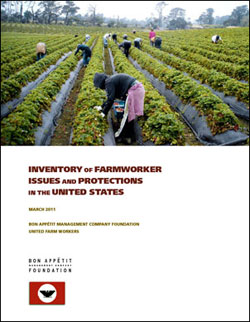
Inventory of Farmworker Issues and Protections in the United States, by Bon Appetit Management Company Foundation and the United Farm Workers of America, March 2011.

It’s great to see farmworker issues getting some attention, but what really caught my eye was the fact that a foodie group and a farmworker group had co-authored the report together.

After spending years incrementally improving the environmental impacts and profitability of food production through organic agriculture and other labeling systems, foodies have become increasingly interested in improving the social conditions of food production too.  While this conversation has most often centered around how to make improvements in working conditions on organic farms, this new report takes a much broader view.  It analyzes working conditions for farmworkers nation-wide, as well as the scanty legal protections available to them.

One of the current debates in foodie circles centers on the pros and cons of trying to solve our food system’s problems with market-based tools: organic certification, fair-trade certification, buying local, etc.  Should we rely on voluntary improvements by individual farmers who can then charge more for their products to consumers willing and able to spend more?  Or should we focus instead on legislative solutions that require improvements by all farmers?  While foodies have mostly used market-based solutions in their work, farmworkers groups have focused largely on legislative solutions.

My reading of the report suggests that its authors are pursuing a middle path.  They hope that increasing the visibility of farmworker problems in this country will also increase consumer interest in purchasing food that is grown under safe, dignified working conditions.  Then, more farmers will want to participate in labeling programs that require improvements in working conditions. These increasingly popular labeling programs will then help generate more interest in and awareness about the problems facing farmworkers, helping legislative solutions become politically feasible.  I’ll be watching to see where this foodie/farmworker partnership will lead.

Here’s a few other items of interest that passed through my in-box last week:

Will work for justice… and honey

The coming of spring means I’ve started to work my bees again after avoiding them all winter.  The hives were a birthday present the year I turned 24, and I’ve carted them around almost everywhere I’ve lived since then.  This means they’ve spent most of their time in various hippie-towns of Northern California – Bolinas, Berkeley, Santa Cruz and Pescadero, with a few years expanding their horizons in the suburbs as well.

My  social science roots show in my almost complete lack of knowledge about actual bee biology.  I know enough about the fundamentals to get the honey, but not much more.  The people I help get started in beekeeping very quickly surpass me in their knowledge of bee breeds, hive behavior, and colony collapse disorder.  BUT, I’m dying to read social geographer Jake Kosek’s next book.  Anyone who hears his talk “The Militarization of the Honeybee” can never look at bees the same way again.  I just hope mine aren’t spying on me yet.

*     *     *

Ken Duckert hosted my bees in his backyard until recently, and used his intimate acquaintance with them to build up this lovely collection of “bee potraits” of my fuzzy friends.  I’ve also put together a few photos of my own below.

This slideshow requires JavaScript.