New digital project in honor of Teresa De Anda

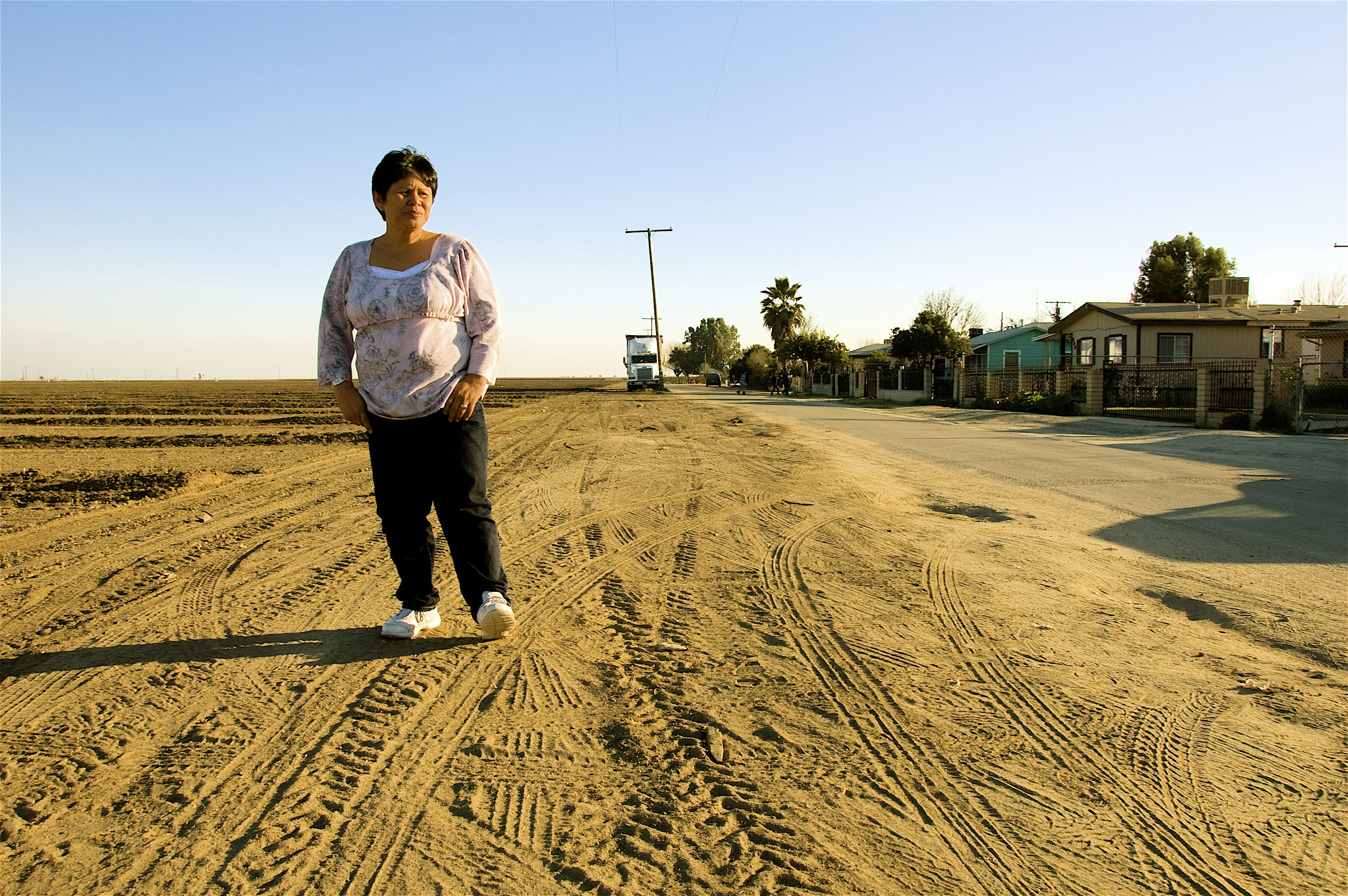
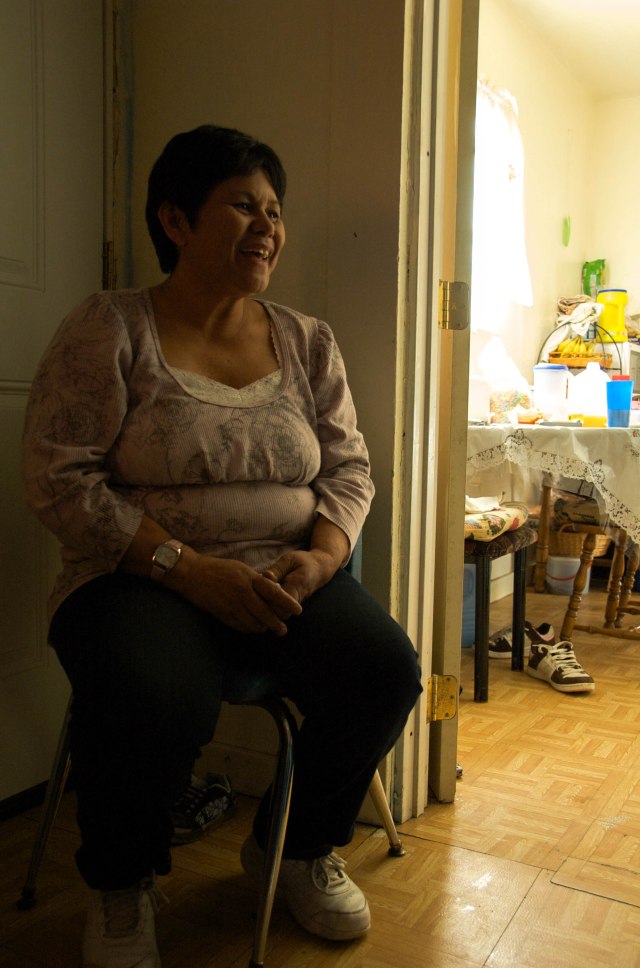
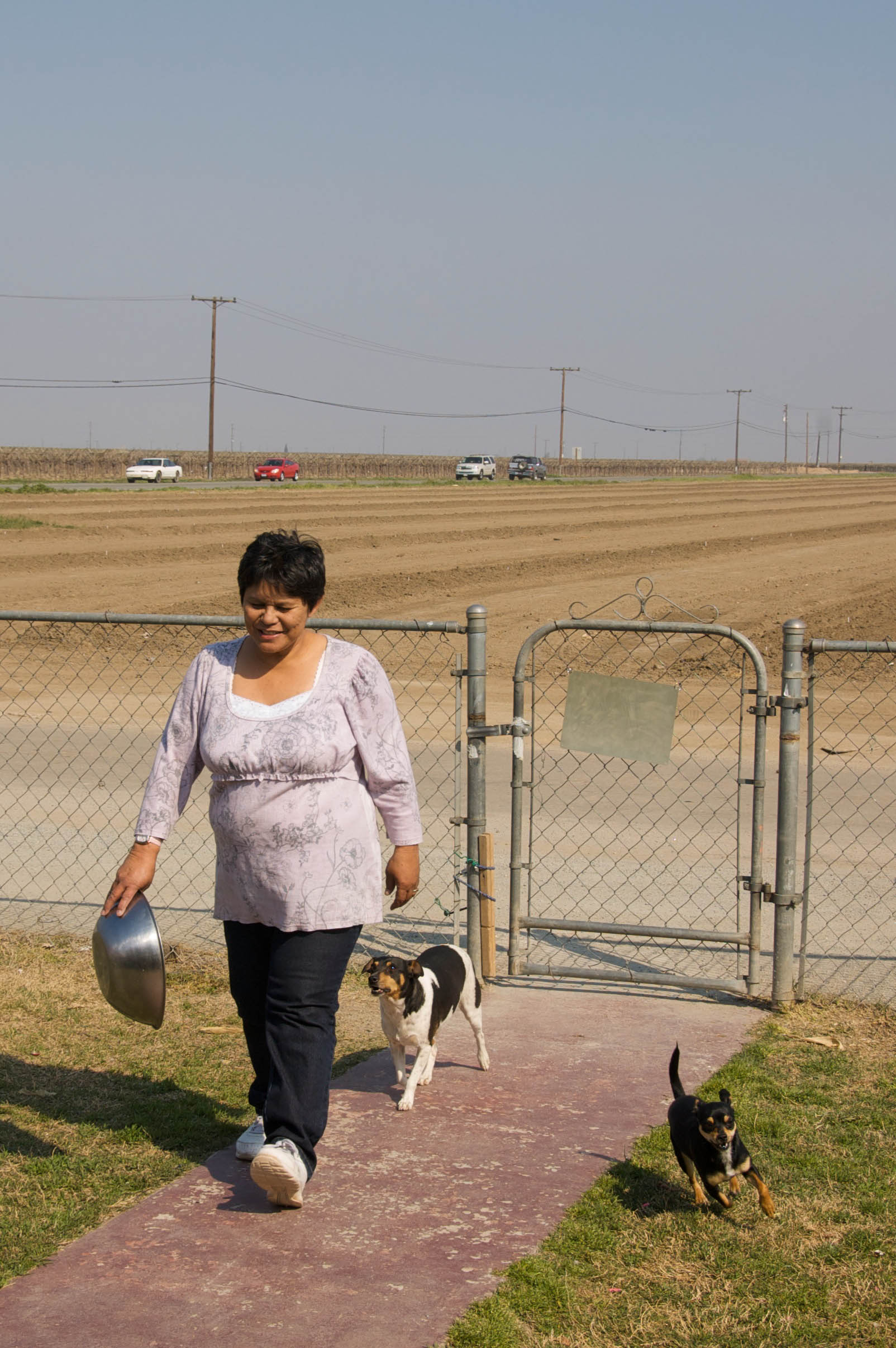
Today I released a new digital project to honor the memory of California pesticides activist Teresa De Anda, and to help educate the public about the problem of pesticide drift. In Her Own Words is an expansion of the blog post I wrote the day before Teresa’s memorial service last fall. It includes photography, new and previously published oral history, suggestions for readings to use with the website in college classrooms, links to resources to help address the problem of pesticide drift in community settings, and a short essay I wrote about Teresa.

Thank you, Valerie Gorospe, for allowing me to continue to work with your mother’s stories, and to share them with others so they might learn from everything she accomplished. Thank you also for your support Linda MacKay, Lauren Richter, Tracey Brieger, Sarah Aird, Tracey Osborne, Rachel Deblinger, Zoe Stricker and Evelyn Torres Arellano.

DSC_0153 copy

With Teresa, in front of a photo I took of her, at an exhibit of my photography in Fresno. February 10, 2011.

In Memory of Teresa DeAnda

I first met Teresa DeAnda in 2007 when I sat in on one of the monthly meetings of the Center on Race, Poverty and the Environment’s Delano Advisory Board. I was there to describe my master’s research and ask the community leaders on the advisory board if they would be willing to participate in it. At that time Teresa was the group’s president, and she was quick to say yes. I learned over time that this generosity of spirit was core to who she was.

As she has done for so many others, Teresa invited me into her home to tell me about her life and her work. Over the years I continued to get to know Teresa through photographing her, through her participation in Voices from the Valley (formerly called 25 Stories from the Central Valley), and through the many other environmental justice events that led our paths to regularly cross. I came to know her as generous, fierce, and a lot of fun.

Teresa lived next to vast fields of industrial agriculture. When we first met she told me about the regular pesticide drift she experienced in her home in Earlimart. She told me about how many people in her community had cancer.

She later got cancer herself. Her death at 55 is made doubly tragic by the fact that it is hard to think of her illness as random, rather than as part of a consistent pattern of toxic exposure in politically marginalized communities. Much of her life’s work involved changing this pattern. Her efforts helped put protections into place that limit the drift of pesticides into residential areas in a number of San Joaquin Valley counties, and that improve emergency response to pesticide drift incidents statewide. She was a bright light whose loss will be deeply felt.

So others might also know of her life and her legacy, I have collected below previously published excerpts from my 2007 interview with Teresa, along with some of my favorite photos of her. I have also included links to other testaments to her life, as well as information for her memorial service in Delano tomorrow morning.
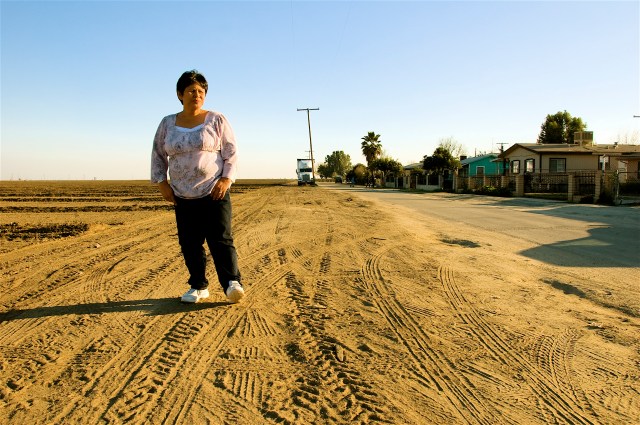
TeresaOutFront copy

Our street was the first street to get evacuated [after the pesticide drifted off the fields and into our neighborhood]. I’d driven to Delano, and when I came back there was a sheriff standing at our gate. It had just gotten dark, and my husband said, “We need to get out, because there’s something happening.” I smelled it a little bit, but I didn’t smell it that strong. But I was still very disturbed. It’s a horrible feeling, getting told you’ve got to get out, that there’s something that you shouldn’t be smelling. I got the kids, and we left in the van. My husband got my blind uncle and my 87-year-old compadre, and then we drove. But I was just so fearful for the people that were staying.

Days later, we found out what happened to everybody. I had read the newspaper, but it didn’t mention what happened to the people that Saturday night, November 13, 1999. On Wednesday the UFW [United Farm Workers] had a meeting and they had all the agencies there: the county air commissioner, the fire department, an expert on pesticides, Pesticide Watch. It was just packed with mad, angry people. That night, I found out what had happened when we left.

[When the pesticide drifted over the town] the people who were the sickest, they were told to go to the middle school. And at the middle school they told the men, women, and children to take off their clothes and go down the decontamination line. Keep in mind: these people were vomiting and had burning eyes, just coughing and coughing, and so they were scared to death. They were given no privacy, just two tarps on either side, and they were told to take off their clothes. And the people didn’t want to.

One lady said, “Where’s my rights? Where’s my rights?” They told her, “Listen, you have no rights tonight; you’ve lost your rights.” And so she took off her clothes, and she said that that was the worst feeling in the world, because her kids had never seen her without her clothes, and they could see her. This is indicative of how they did the decon [decontamination]. She took off everything, absolutely everything, but she wouldn’t take off her underwear, so they yanked it off. They yanked off her Nikes, and so there she goes through the decontamination line, which was a fire-department water hose, on a cold November night. A fire-department water hose with a guy standing there holding it. She went through one line and then the other, but they didn’t wet her hair. At the end of the decon line they were supposed to have ambulances waiting, but the ambulances weren’t there yet, so they just gave them little covers and told them to sit on the ground.

So I’m finding all this stuff out at the meeting. All these mad people are just yelling at the agencies, telling them, “How could you do this to us?” And then they told us what had happened at the hospital. The people did get transported to the hospital. Some went to Tulare Hospital, some went to Porterville Hospital, some went to Delano Hospital. Well, the lady with a lot of kids, she was baby-sitting kids too, they couldn’t take all of her kids to the same place, so they wrote their phone numbers on their stomachs, like they were animals. At the hospitals, they took their information, their names, their number, their address, but they didn’t even triage them. The doctor called poison control, and poison control said, “There’s nothing happening to them, just tell them to go back home but to try not to get re-exposed.” That’s all poison control told them. So they were sent on their way and they were given the clothes that they had been in before they got decontaminated. They just gave them back to them. Didn’t have them cleaned.

So I started learning more and getting more and more angry. I couldn’t sleep at night, ’cause I was so upset at how it had changed my kids’ health and my health. When I was growing up, my dad had always said, “Trust the government. The government’s never going to lie; the government’s good,” and all that. And I thought, “No, they’re not,” because they really let us down that night, they really, really let us down. So much for trusting the government. I couldn’t sleep at night because it bothered me so much that it happened and that still nothing was being done about the people who had gotten sick. I learned a lot about pesticides. And then at press conferences they would always ask me to speak. Even though I wasn’t one of the victims that got deconned, I was one of the ones speaking all the time. They were calling me for meetings and conferences and stuff to talk about what had happened.

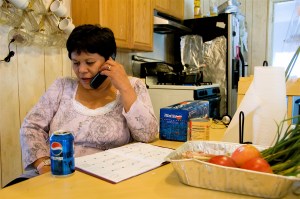
WTeresaKitchen copyhat happened in Earlimart was in November, so by September, UFW and us, we had formed El Comité Para el Bienestar de Earlimart [Committee for the Well-Being of Earlimart]. All of the people were victims of the accident. They were all mostly farm workers. Just a couple weren’t. We started having meetings, our own meetings without UFW, still supporting UFW in any press conference they wanted us to, but then we started having our own meetings. And then in September of 2000 we asked the farmer and the chemical applicator to pay the medical payments for the people that had asthma. It was coming out that people had gotten asthma—didn’t have it before that night in 1999—just like that, from that night, that exposure. And it had gotten in their mucus membrane and then in their lungs. And so they needed long-term treatment. We got Wilbur-Ellis [the company hired by the farm to apply the pesticide] to pay for that.We had a big press conference, right here at the house. And that was a big victory. The State of California Department of Pesticide Regulation gave Wilbur-Ellis the biggest fine that had ever happened. It’s still peanuts compared to other fines for toxic spills and stuff, but it was the biggest for pesticides. [Note: Pesticide specialists later told the activists from Earlimart that the particular chemical they had been exposed to is activated by water and that they should not have been hosed down as part of the decontamination process.]
– Source: Perkins and Sze, 2011 

***
Once there was a guy spraying, it was May, 1999, and he was spraying over there and the fog was in the house.  He wasn’t even turning off the tractor rig when he was coming up the road.  The stuff he was spraying, it was in the house.  My kids were all puking, my husband was out of town, so it was just me here.  I didn’t know to pick them up, take them to the van, and get them out of there. It looked like London fog out there, and in here it looked like San Francisco fog.  I didn’t know whether to leave them sleeping, or to take them out to more danger.  So I called the fire department, the sheriff, and they both said the same thing: “The farmer has a right to farm.  You can’t complain about this.”  And I said, “But I don’t know if we’re going to die or live or what.  This stuff, it’s really bad out here.  I know he’s got to spray, I realize that, just tell him to turn the things off when he’s coming out of the vineyards.”  You know what a tractor rig looks like?  Kind of like a monster.  It’s a noise, and then you look out, and then there’s lights.  It was in the night, so they said that they couldn’t come out.  I said that you’d better come out here and at least look at this.  I wanted it on record that I called them.
***

The next day was a Saturday, and they applied the pesticide again.  This time instead of going west, it went south.  And south, there was a low income housing complex,  I guess about 100 people live there.  They began smelling it, and they began getting sick, a bunch of kids out on the lawn vomiting.  A bunch of people from that place were calling 911, calling for help.  And basically, this is what happened from Flores’ point of view, Flores Baptista.  She said she was baby-sitting her nine month old nephew.  She was holding him in her arms.  She has a lot of kids, all of her kids were outside, vomiting.  And the baby was in her arms, and she was on the phone with 911, and she told them, “My kids are outside vomiting, there’s something going on here, we think it’s the spray.  You need to come do something about it.  Everybody’s kids are outside vomiting, and we just need some help out here.”  And the operator told her, “Just hold on, we’re trying to figure out what’s going on.  Just calm down.  I think your being calm will have a big impact on your kids, and you need to just calm down.”  And so Flores said, “OK, well I’m trying to relax, but my kids are out here, and they’re getting sicker and sicker.  And the baby I’m baby-sitting is breathing really weird, and I’m really worried about him.  I don’t know if he’s going to make it or not.  And my nephew’s looking real bad.”  And the operator kept telling her, “Look, you’re hysterical.  You need to calm down.”  This went on for 45 minutes.  They kept them on the phone for 45 minutes.  And so after 45 minutes, Flores said, you know what, and she said some bad words, and she said “I’m just going to get out of here.  I’m not going to wait for your guys.  You guys obviously aren’t coming, and I don’t know what you’re doing, but everybody’s about to die here.  We need to get out of here.  It smells so bad.”

So she got in her van, and she drove out.  And at that time, other people slammed the phone down.  When they saw people leaving, they slammed their phone down, and they got out, and they were leaving too. And so there was a caravan of vans.  They drove out to Sunset and Weed Patch. And on the corner, it was barricaded.  It’s called a stop and freeze, or freeze and keep whatever is contaminated in. They were telling people “Go back, go back, you can’t come out.”  And they’re like “No, we’re sick, and need our kids to get to the doctor.  We’re going to drive them ourselves, cause we’re not going to wait for you any more.  We were on the phone for close to an hour with that lady, and she was just telling us to sit down, to calm down, and that we were talking crazy and stuff, but no, we’re going to get out.”  And there was a lot of people that spoke Spanish.  So one of the men just went on the dirt and drove off.  Broke the barricade.

– Source: Voices from the Valley

***
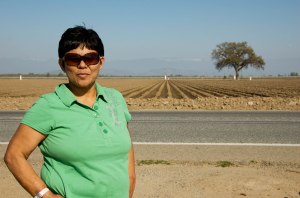
Teresa.OnRoadTeresa describing visiting residents of Arvin, CA, after a pesticide poisoning incident there in 2002:

I wanted to talk to the people and let them know that when the doctors and the agencies, like the fire department or whatever, tells you it’s nothing… because they will, they’ll tell you it’s nothing.  They’ll say “Oh, it’s mass hysteria, you’re hung over,” or, “It’s just something you ate that’s making you nauseous.”  No, it’s the pesticides, and don’t doubt it.  It’s the pesticides.  Then I always want to tell them that they need to report drift.  It’s state law, drift is illegal, it shouldn’t happen.  The farmers spray the field, it leaves the field, goes on your car, goes on your property, goes on the park when you’re there. You need to report it.  I’m trying to get it across, but people still don’t call.  The numbers are so low for reports.

***
I was at a meeting with the county agricultural commissioner, and we were looking at maps of the agricultural land. I saw these little red dots on the map and asked what they were. He said, “Those mark where the bees are, they’re the buffers.” I said, “The bees have buffers and we don’t?!” He said, “Teresa….,” but I was serious.
***
I had no idea what an activist was. Now I know there’s a name to it, not just “troublemaker.”
 Teresa.InNeighbor'sHosue

Teresa.LecturingTeresa.Frontyard

On Becoming a Public Sociologist: Amplifying Women’s Voices in the Quest for Environmental Justice

60853_9781452242026I received my free copy of the recently published Sociologists in Action on Inequalities: Race, Class and Gender in the mail this week, and turned immediately to the short essay I contributed. My piece, “On Becoming a Public Sociologist: Amplifying Women’s Voices in the Quest for Environmental Justice” describes my process of becoming a public sociologist through the Voices from the Valley multi-media project on environmental justice activism in California’s agricultural San Joaquin Valley. The chapter is meant to show undergrads some of where sociology might take them. It was a fun project, and I’m looking forward to reading the other contributions in the book.


Here’s the full citation for my piece:

  • Perkins, Tracy. 2015. “On Becoming a Public Sociologist: Amplifying Women’s Voices in the Quest for Environmental Justice.” Pp. 88-92 in Sociologists in Action on Inequalities: Race, Class and Gender edited by S. K. White, J. M. White and K. O. Korgen. Los Angeles, CA: SAGE Publications.


And here’s a citation to the scholarly article that grew out of the same set of interviews that formed the basis of Voices from the Valley:

  • Perkins, Tracy. 2012. “Women’s Pathways Into Activism: Rethinking the Women’s Environmental Justice Narrative in California’s San Joaquin Valley.” Organization & Environment, 25(1):76-94.


Visual Activism Symposium organized by SF Museum of Modern Art and IAVC

This morning I finished putting together slides of some of my photography, uploaded a short bio to a shared dropbox folder and timed myself while going through my talking points. I’m ready for my eight minutes of fame!

I’m pleased to be participating in the Visual Activism symposium organized by the San Francisco Museum of Modern Art and the International Association for Visual Culture this Friday and Saturday. Because the museum is closed for renovations for several years, the MOMA is organizing off-site events under the label of “SF MOMA On the Go.” This event will be held at the Brava Theater in San Francisco’s Mission District. I’ve been told it is an “antique” theater originally designed for Vaudeville performances, so I’m looking forward to checking it out.

I’ll be on the first panel, “Environment, Justice, Inequity.” Come say hello if you see me there! I’ll show a few photos and talk about how I engage the following themes in the Voices from the Valley project about environmental justice activism in California’s San Joaquin Valley:

  • Making the invisible visible
  • Rethinking the rural pastoral
  • Everyday life, everyday politics
  • Tragedy and hope
  • Beauty
  • Recognition

“25 Stories” grows up!

This month I proudly released an expanded, updated version of the 25 Stories from the Central Valley website.  Please meet…. Voices from the Valley!  In addition to the original photo exhibit and teaching aides, it includes these new features:

  • An interactive photo and oral history collage
  • San Joaquin Valley environmental justice news coverage
  • Slideshow of our playback theater events with Kairos Theater Ensemble
  • Environmental justice syllabus collection
  • A map of the San Joaquin Valley towns where we’ve taken photos and collected stories
  • An expanded list of groups working toward environmental justice in the San Joaquin Valley, and links to their social media
  • Suggestions for how you can volunteer

Lots of people helped make this relaunch happen, but the project is especially indebted to tech wizards Tyler LaGue (formerly of the John Muir Institute of the Environment at UC Davis), Allen Gunn and the rest of the team at Aspiration, and Grant Kinney of GMK Design. See a full list of the people and organizations involved with this project throughout its history here and here. I continue to be honored to know the environmental justice activists who have so generously shared their stories with me over the 6 years since this project began.

Read on for some of the thinking behind the changes…

Cumulative impacts: One of the concepts that environmental justice advocates regularly invoke is ‘cumulative impacts.’ People are exposed to multiple pollution sources as they go about their daily lives, not just one at a time.  However, our regulatory structure is largely inattentive to this reality, and often grants permits for new pollution sources by assessing them individually rather than assessing their contribution to the cumulative burden of pollution already felt in that area. Needless to say, poor people and people of color bear a higher cumulative burden of pollution than the rest of us.  The new Voices from the Valley website has several features intended to support this framing.

  • News feed/archive: By collecting news sources about all environmental justice issues in the Valley in the same place, the news feed underscores the multiple, intersecting pollution problems in the region.  This comes across particularly well when you navigate to the archive view and look at a long list of headlines from the year. I could using a screenshot of this page in a classroom setting when teaching cumulative impacts.
  • Collage: The collage features photos and first-person quotes/stories.  They can be sorted and viewed by theme (ie ‘water,’ ‘air,’ ‘pesticides’ etc), but the default view is to have all of the categories show at once.  (However, I think this feature still needs a little work to be more user friendly – suggestions welcome!).
  • Map: The map provides a way to visualize where all of the communities featured in the project are in relation to eachother.  Clicking on many of the town names opens up a pop-up window with photos from the photo exhibit. In the future, I’d love to enhance this feature to include data on the various pollutants felt at each of these locations.

Multiple learning styles: The new site is designed to work with as many different learning styles as possible.  It features slideshows, interactive collages, oral history, activity and lecture ideas for the classroom, and a searchable news archive that includes articles, videos, radio, television and digital multimedia projects. (When the first version of Voices from the Valley launched 5 years ago, we also did several interactive theater shows with Kairos Theater Ensemble. See this post for a description).

Social media: Advocacy groups are increasingly using social media channels to get their message out. The new site’s list of relevant organizations in the San Joaquin Valley now includes links to their twitter and facebook channels, as well as a way for viewers to subscribe to all of their twitter channels at once. We also now have our own Voices from the Valley twitter and facebook accounts. The folks at Aspiration have been a big help in thinking through how these accounts can promote the project’s goals.  I’m having a lot of fun experimenting with how to use them to engage in public conversations and connect to like-minded organizations.

New name: ’25 Stories from the Central Valley’ was a great name, but inaccurate in a lot of ways. The original name was built around the 25 interviews I did with women environmental justice leaders in the Central Valley. The idea was that I would edit each of their interviews into stand-alone stories for the website… hence ’25 Stories.’ Only thing is, that was a much bigger project than I realized when I picked the name, and I never made it happen.  So then I decided that if the photo exhibit was made up of 25 photos, that was close enough for the name to still work. But it got tiring explaining that to people, and eventually I also wanted more flexibility in the number of photos I could include in the  exhibit. Also, when I started the project I thought it would cover the entire Central Valley, but the environmental justice movement is at its strongest in the southern half of the Central Valley (the San Joaquin Valley), and all the women I interviewed lived there or got started there. The more familiar I got with the area, the more I realized how distinct the San Joaquin Valley is from the Sacramento Valley (together they make up the Central Valley), and how the project name needed to reflect that.  ‘Voices from the Valley’ got around the problems associated with the last name, and is a broader platform for growth in the future.  Talking all of this through with the folks at smartMeme was a big help!

Photos showing at the Fresno Regional Foundation

I got word today that the photos in my 25 Stories from the Central Valley collection have been hung and are already generating good conversation at the Fresno Regional Foundation.  I haven’t seen how they look yet so if you are visiting their offices while they are on display over the next six months, snap a photo of them and send it to me!

Visions of the San Joaquin Valley

I spent time yesterday looking at Barron Bixler’s photographs of agriculture in the San Joaquin Valley.  He’s arranged his photos into a beautiful slideshow set to music called A New Pastoral: Views of the San Joaquin Valley.  I’ve formed my own vision of the San Joaquin Valley over the last few years, and it’s fascinating to see how someone else views and presents the region.  Some of Bixler’s photos depict scences familiar to me – stark  landscapes of row-crops, orchards with factories in the background, agricultural machinery, railroads and storage facilities.  I loved seeing these familiar places through his eye. Others show places I’ve never been, like the inside of an industrial milking facility.

Bixler’s photos are entirely devoid of people – they depict industrial agriculture through the landscape and built environment it creates.  Matt Black’s photos, on the other hand, center on the immigrants and farmworkers living and working in the San Joaquin Valley.  They are entirely human. I enjoyed checking his captions to see if the small towns he has depicted were places I’ve spent time in too (mostly not).  He has also created a powerful digital project about the birth defects in Kettleman City.

David Bacon’s work doesn’t focus on the San Joaquin Valley per se, but he has a number of photo collections of farmworkers, immigrants, and UFW advocacy set there.  See his work here and here.

Finally, Ken Light’s new photographic book, Valley of Shadows and Dreams, will be published soon by Heyday Press.  I saw some of his work on this project when I took his documentary photography class several years ago at UC Berkeley, and can’t wait to see the finished product.  Check out the photo on the book’s cover, it’s gorgeous.

And, here’s a link to my own humble efforts to photograph the San Joaquin Valley.  I try to show the grave environmental health problems facing this region, but also the hard work being done by its residents to change things. I also try to convey my sense of this under-appreciated part of our state as beautiful in its own right. An updated version of this collection will be online soon, as well as a nifty new collage that combines new photos with oral history.

Ode to my web designer(s)

One of the really fun parts of my work over the last few years has been getting to work with web designers to build the 25 Stories from the Central Valley website.  In 2008, Derek Hunziker from the John Muir Institute for the Environment at UC Davis built the current site, and over the last few months I’ve been working with his replacement Tyler LaGue to add more content and revamp the site’s look and organization.

Derek built me a beautiful site that I loved.  I had a blast dreaming up ideas and seeing him bring them to life, only better.  The only problem was that it was really hard to update.  When we launched the site, clicking on one of the key menu items brought up the optimistic message “Coming soon!”  Three years later, the message still hasn’t changed.  : (

In the meantime, I met Aspiration’s tech guru Allen Gunn at the Greenaction holiday party last year.  He immediately diagnosed the problem as having created a custom-built website that locks me into relying on a programmer to make changes instead of a pre-fab one designed for people like me to be able to manage.  That meant that any small correction or addition I wanted to make had to wait to be addressed until I could fundraise more money to hire another programmer to make the changes.  That conversation launched my experiment with WordPress and this blog.  I had a great time browsing among the many looks available and and setting it up to appeal to my aesthetics.  It’s a much more whimsical, personal site than the 25 Stories site, and the look reflects that.

Now, Tyler is rebuilding the 25 Stories website to reflect the best of both worlds.  It’s a WordPress site that I’ll be able to update on my own, but he is using his programming magic to make it do more than I could.  We’ll finally do away with the “Coming soon!” message and replace it with an interactive collage  that features excerpts from my interviews with women environmental justice leaders of the San Joaquin Valley.  We’ll also have a slide show of the project’s playback theater performances by Kairos Theater Ensemble, and a media feed that collects and archives coverage of San Joaquin Valley environmental justice advocacy.

The whole process has been a blast, and a great way to balance out the other kinds of work I do.  I get to dream up what I want, bounce ideas around with Tyler, and then see how he magics them into existence. It’s richly creative and entirely satisfying.  Plus, how many times in your life do you get to hear someone say, “Whatever you want, we can make it happen.” ?!?  Stay tuned for the final product!

Introducing Ruth Martinez

Ruth Martinez is a community organizer who lives in the small town of Ducor in the San Joaquin Valley. I interviewed her several years ago for my Master’s thesis and wrote the story below based on what she told me about how she came to be an activist. I stopped by her house this morning to get her permission to share her story.  Ruth was keeping off her feet after having broken her foot on a recent United Farm Workers of America (UFW) march to Sacramento.  Besides her involvement with the UFW, Ruth is also active with the Center on Race Poverty and the Environment, the Community Water Center, and the Asociación de Gente Unida por el Agua

Ruth’s story begins with her marriage at 15.  Her husband was a farm worker who was active in the UFW.  She joined him on the marches and political campaigns that were connected with his work.  Ruth had always wanted to be a nurse, but from a young age she had epileptic seizures.  As she told me, “César Chávez never said, ‘No, you can’t.’  That’s why his slogan was ‘Si, se puede,’ because yes, you can.”  Ruth’s husband took her to a UFW meeting at 40 Acres in Delano, which had a clinic for farm workers at that time.  Ruth saw the nurses and said, “Oh, I always wanted to be a nurse.”  César heard her and said “Well, why aren’t you?” Ruth said, “Because I can’t.  I get seizures and everybody’s told me I’d never be able to be a nurse because of my seizures.”  César said, “You can be anything you want to,” and helped her go to nurse’s aide training.  Ruth worked as a nurse’s aide until she finished college and received her nursing degree.  She was a nurse for 30 years before retiring.  After one month of retirement she became tired of not doing anything and went back to work.  Now she works at a unionized (UFW) rose farm, taking out the thorns that get stuck in the farm workers hands, face and eyes and seeing to other health problems as well.

During her years as a nurse Ruth would go on the UFW marches to take care of people who got sick or who had too many blisters on their feet from marching.  She remembers one march from Delano to Sacramento in particular.  She got upset because the organizers put her in a van to tend to the sick but she wanted to be out marching.  She describes the impact of starting with about 20 people in Delano and ending in Sacramento with thousands.  She remembers how the Teamsters and just about everyone else worked against them on that march, and how different it was from a march from Merced to Sacramento that they did around 1990 or 2000.  This time the Teamster’s lent them their hall in Sacramento to sleep in; the police provided an escort; and truckers stopped to get them sodas and water to drink as they marched.

Ruth and her family moved from a home surrounded by a grape orchard to the small town where she still lives.  Her family, and many of the neighbors, had “self-help” houses built for them because of their low-income status.  Early on there were problems with the water supply in town, and residents were told not to flush their toilets at certain hours, and to only take showers at other hours.  Ruth felt this wasn’t right and asked her sister, who worked at a regional non-profit, to send a legal assistant over to help resolve the problem.  Ruth began collecting signatures in town to replace the private water company with a community service district that the whole town would co-own.  The campaign was successful and very personally meaningful to Ruth, who years later ended up on the water board for the town.

For a time the water system worked well and provided them with clean water, albeit sometimes at low pressure.  But later the town began having problems with their water again.  This time it smelled terrible and in many houses came out looking brown and muddy.  Ruth had already been introduced to the environmental justice organization nearby, and began working on the water problem with one of their organizers.  They formed a committee for people in the San Joaquin Valley with water problems, and went to Sacramento, Fresno and San Francisco to attend various water board meetings in an attempt to resolve their problem.  Ruth faced strong opposition from her local board when she brought bottles of the smelly brown water collected from neighbors’ homes as examples of what they had to live with.  Ruth and the other neighbors still had to pay for the poor-quality water that they were receiving. She used bottled water to cook with but bathed in the tap water, although she used bottled water to wash her hair so it would not retain the sewage smell of the tap water.  Ruth’s grandchildren would come to visit and Ruth would bathe them, but then her daughter would find rashes on the children, which they decided must have been caused by the water.  During this time several of Ruth’s old UFW friends joined the nearby environmental justice group, and began inviting her to meetings that they were organizing on pesticide buffer zones and the possibility of receiving a grant to put in sewage lines in her town.

Ruth’s father died when she was young.  Her mother spoke little English, and Ruth credits her with very little influence in terms of her own work as an activist. Somehow she and her sister ended up being the only ones in their family who were “a little pushy”, and tried to fix things when they thought something was wrong.  She thinks the female movement must have had a lot to do with it.

Toward the end of our interview I asked Ruth if she has any children, and she told me that she has four.  Ruth’s first child is the healthiest, and she was born before Ruth and her husband moved to a home in the middle of a grape orchard.  Of the second two children born on the ranch, one was born with only one kidney* and one has high blood pressure and diabetes.  The fourth child has a serious case of asthma.  Ruth attributes the child born with one kidney and the other child’s asthma to the pesticides to which they were exposed.

Now, at 65 or a little older, Ruth is still working as a nurse.  She works on local and regional water issues, and continues to support political campaigns that are backed by the UFW.  Most recently, she went to Los Angeles to support Antonio Villaraigosa’s campaign to be the first Latino mayor.  She walked the streets and talked to the voters on election day.  She also works with Catholic Charities registering new people to become citizens.  Her husband died 12 years ago of a heart attack and diabetes.

* Ruth’s daughter passed away in November of 2010.

Spanish language teaching tools for environmental justice

Yesterday one of the excellent tech masters at UC Davis uploaded the most recent addition to the 25 Stories from the Central Valley website: Teaching tools in Spanish (click the ‘en español’ icon in the upper right corner if the link pulls up the English version).  The tools were designed to help college-level teachers introduce basic environmental justice concepts in the classroom, but I imagine some of them could be adapted to work in other settings as well.  Three of the tools depend on English-language documents and data available online, but I decided to include them also in the hopes that others might know of Spanish-language equivalents to use.  Enjoy!

Thank you to Mateo and Roy at Berkeley Interpreting, Transcription and Translation Services for doing the translation, to Silver Cruz for updating the website, to Ed Reed at the UC Davis John Muir Institute of the Environment for getting it online, and to the UC Humanities Research Institute for paying for it!