Introducing Ruth Martinez

Ruth Martinez is a community organizer who lives in the small town of Ducor in the San Joaquin Valley. I interviewed her several years ago for my Master’s thesis and wrote the story below based on what she told me about how she came to be an activist. I stopped by her house this morning to get her permission to share her story.  Ruth was keeping off her feet after having broken her foot on a recent United Farm Workers of America (UFW) march to Sacramento.  Besides her involvement with the UFW, Ruth is also active with the Center on Race Poverty and the Environment, the Community Water Center, and the Asociación de Gente Unida por el Agua

Ruth’s story begins with her marriage at 15.  Her husband was a farm worker who was active in the UFW.  She joined him on the marches and political campaigns that were connected with his work.  Ruth had always wanted to be a nurse, but from a young age she had epileptic seizures.  As she told me, “César Chávez never said, ‘No, you can’t.’  That’s why his slogan was ‘Si, se puede,’ because yes, you can.”  Ruth’s husband took her to a UFW meeting at 40 Acres in Delano, which had a clinic for farm workers at that time.  Ruth saw the nurses and said, “Oh, I always wanted to be a nurse.”  César heard her and said “Well, why aren’t you?” Ruth said, “Because I can’t.  I get seizures and everybody’s told me I’d never be able to be a nurse because of my seizures.”  César said, “You can be anything you want to,” and helped her go to nurse’s aide training.  Ruth worked as a nurse’s aide until she finished college and received her nursing degree.  She was a nurse for 30 years before retiring.  After one month of retirement she became tired of not doing anything and went back to work.  Now she works at a unionized (UFW) rose farm, taking out the thorns that get stuck in the farm workers hands, face and eyes and seeing to other health problems as well.

During her years as a nurse Ruth would go on the UFW marches to take care of people who got sick or who had too many blisters on their feet from marching.  She remembers one march from Delano to Sacramento in particular.  She got upset because the organizers put her in a van to tend to the sick but she wanted to be out marching.  She describes the impact of starting with about 20 people in Delano and ending in Sacramento with thousands.  She remembers how the Teamsters and just about everyone else worked against them on that march, and how different it was from a march from Merced to Sacramento that they did around 1990 or 2000.  This time the Teamster’s lent them their hall in Sacramento to sleep in; the police provided an escort; and truckers stopped to get them sodas and water to drink as they marched.

Ruth and her family moved from a home surrounded by a grape orchard to the small town where she still lives.  Her family, and many of the neighbors, had “self-help” houses built for them because of their low-income status.  Early on there were problems with the water supply in town, and residents were told not to flush their toilets at certain hours, and to only take showers at other hours.  Ruth felt this wasn’t right and asked her sister, who worked at a regional non-profit, to send a legal assistant over to help resolve the problem.  Ruth began collecting signatures in town to replace the private water company with a community service district that the whole town would co-own.  The campaign was successful and very personally meaningful to Ruth, who years later ended up on the water board for the town.

For a time the water system worked well and provided them with clean water, albeit sometimes at low pressure.  But later the town began having problems with their water again.  This time it smelled terrible and in many houses came out looking brown and muddy.  Ruth had already been introduced to the environmental justice organization nearby, and began working on the water problem with one of their organizers.  They formed a committee for people in the San Joaquin Valley with water problems, and went to Sacramento, Fresno and San Francisco to attend various water board meetings in an attempt to resolve their problem.  Ruth faced strong opposition from her local board when she brought bottles of the smelly brown water collected from neighbors’ homes as examples of what they had to live with.  Ruth and the other neighbors still had to pay for the poor-quality water that they were receiving. She used bottled water to cook with but bathed in the tap water, although she used bottled water to wash her hair so it would not retain the sewage smell of the tap water.  Ruth’s grandchildren would come to visit and Ruth would bathe them, but then her daughter would find rashes on the children, which they decided must have been caused by the water.  During this time several of Ruth’s old UFW friends joined the nearby environmental justice group, and began inviting her to meetings that they were organizing on pesticide buffer zones and the possibility of receiving a grant to put in sewage lines in her town.

Ruth’s father died when she was young.  Her mother spoke little English, and Ruth credits her with very little influence in terms of her own work as an activist. Somehow she and her sister ended up being the only ones in their family who were “a little pushy”, and tried to fix things when they thought something was wrong.  She thinks the female movement must have had a lot to do with it.

Toward the end of our interview I asked Ruth if she has any children, and she told me that she has four.  Ruth’s first child is the healthiest, and she was born before Ruth and her husband moved to a home in the middle of a grape orchard.  Of the second two children born on the ranch, one was born with only one kidney* and one has high blood pressure and diabetes.  The fourth child has a serious case of asthma.  Ruth attributes the child born with one kidney and the other child’s asthma to the pesticides to which they were exposed.

Now, at 65 or a little older, Ruth is still working as a nurse.  She works on local and regional water issues, and continues to support political campaigns that are backed by the UFW.  Most recently, she went to Los Angeles to support Antonio Villaraigosa’s campaign to be the first Latino mayor.  She walked the streets and talked to the voters on election day.  She also works with Catholic Charities registering new people to become citizens.  Her husband died 12 years ago of a heart attack and diabetes.

* Ruth’s daughter passed away in November of 2010.

Doing sociology in Las Vegas

Las Vegas. 106 degree heat.  6,000 sociologists.  Put them together and what do you get?  The 2011 annual meeting of the American Sociological Association!  Here are the highlights, lowlights and general weirdness from my six hot, loud, strange days in Las Vegas:

– Gave three talks in three days. : (

– Got some awards!  : )

– Indoor smoking.

– Paid $14 to print a two page document.

– Had dinner at the “KGB Burger and Vodka Bar.”

– Beautiful, drought-resistant landscaping at the UNLV campus.

– Misters around town still going at 10 pm, and already on again at 8 am.

– Had my photo taken with Frances Fox Piven!

– Asked Dr. Piven how she handled the Glen Beck attacks and death threats from his followers.  She turned down personal armed guards but did have them posted outside the door of her classroom to protect her students.  : (

– Attended a great talk on blogging by the creators of Sociological Images.  They have something like 600,000 visitors a month and 12,700 Facebook fans.  Check out their recent post on the US Postal Service stamp that features a patriotic close-up of the Statue of Liberty…. the one in Las Vegas.

– Went to the ASA blogger party and met the author of this neat  blog on teaching sociology.  Check out his “Dead Grandmas and Teaching Research Questions” post.

– Heard my advisor Andy Szasz talk about the military’s stance on climate change (it’s real) and what they think needs to be done about it (a lot).  Riley Dunlap pointed out that climate change deniers have given the military a wide berth on this topic. Andy’s point was that the military could be a strong ally to environmentalists.

– Heard the most articulate, eloquent speech of the conference given by a woman from the Las Vegas chapter of the Sex Workers’ Outreach Project.

– $5 “express lane” lines to get into restaurants faster.

– Lounge chairs by the pool that you have to pay to sit on.

– A massive billboard of a woman’s butt at the intersection of Las Vegas Boulevard and Flamingo Road.

– Watched the “Hot Babes Direct To You!” billboard truck go by countless times.  The idea that you could have a woman delivered to your front door like a package was somehow less distressing than the claim that these are “Girls that want to meet you.”

– Was really glad to come home to my own personal brand of weird in beautiful Santa Cruz.

24 hours with 5th Crow Farm

When I moved to Santa Cruz one of the first friends I made was a woman named Teresa Kurtak.  Teresa and her business partners  Mike Irving and John Vars were looking for land to lease so they could start a small organic farm.  They found what they were looking for in Pescadero, and are now in their third growing season there.

Most of the photos I see of small-scale organic farms present them as rural idylls – beautiful, bucolic, peaceful.  My experience watching 5th Crow Farm grow is that organic farms may be beautiful but usually entail working long, hectic days.  My urban lifestyle is probably a lot more peaceful!  Certainly that’s what I thought after tagging along with Teresa while she worked this weekend.  Here are some of my photos and a blow-by-blow account of what we did…

****

8:30 pm, Saturday night: I stop at the grocery store on my way to the farm to buy dinner for Teresa and Mike. They’ve been harvesting for the Sunday farmers’ markets all day and haven’t had time to think about dinner yet.

9:15 pm:  I arrive at Mike and Teresa’s yurt on the farm.

9:30 pm:  Teresa and Mike have dinner, and then Teresa starts to prepare the printed materials she needs for the next day’s special event at the California Academy of Sciences.

10:00 pm:  The printer isn’t working so Teresa heads out to find a working printer elsewhere.  I go to bed.

Midnight:  Teresa goes to bed.

3:16 am, Sunday morning:  Roosters start crowing.   : (

4:30 am: Alarm goes off.    : (

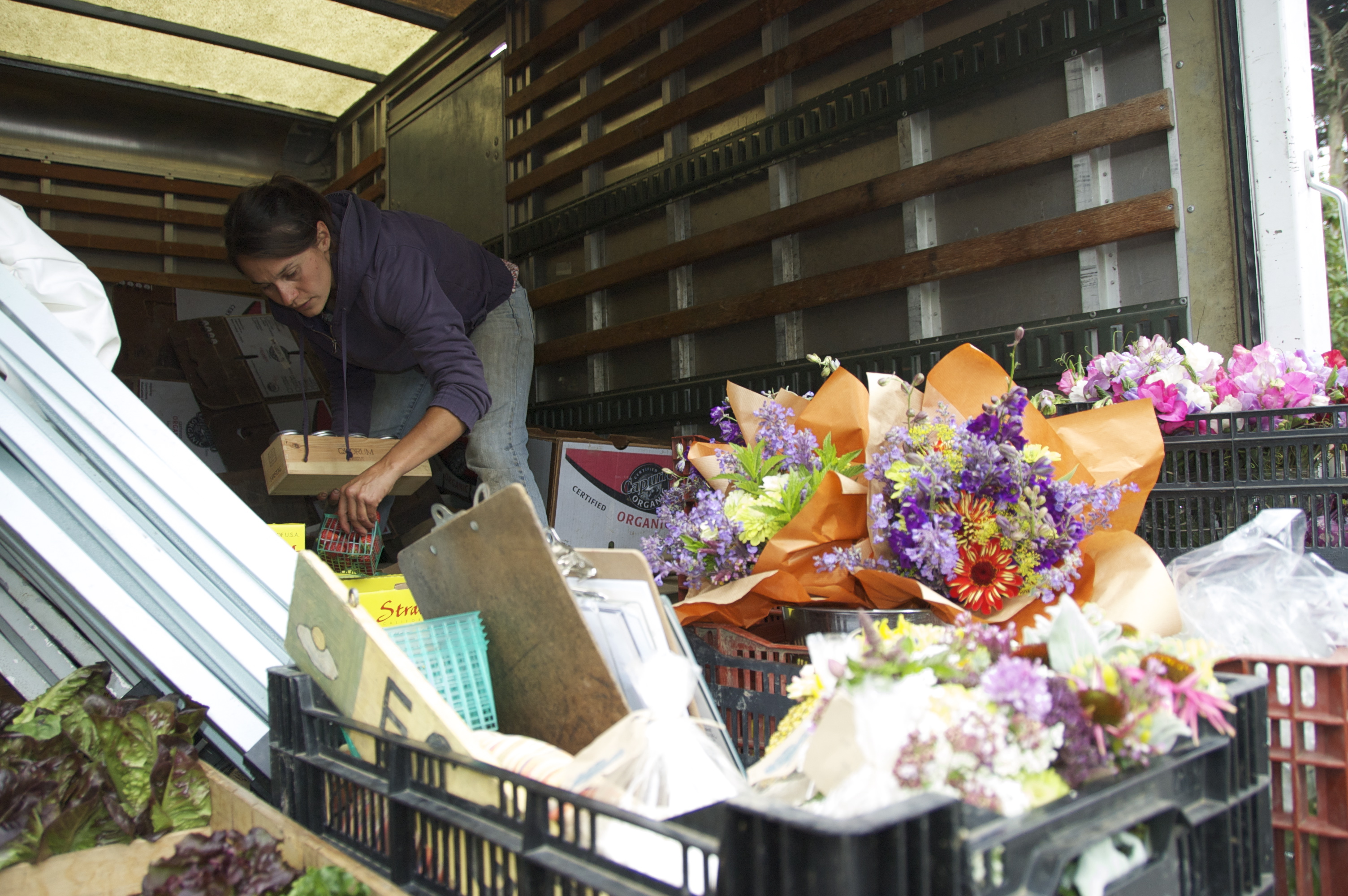
4:45 am: Teresa and I get in the market truck, which they loaded yesterday, and hit the road.

5:30 am: We stop to pick up coffee to help keep us awake on the road.  I also buy a pastry for my breakfast.

5:43 am: Dawn.

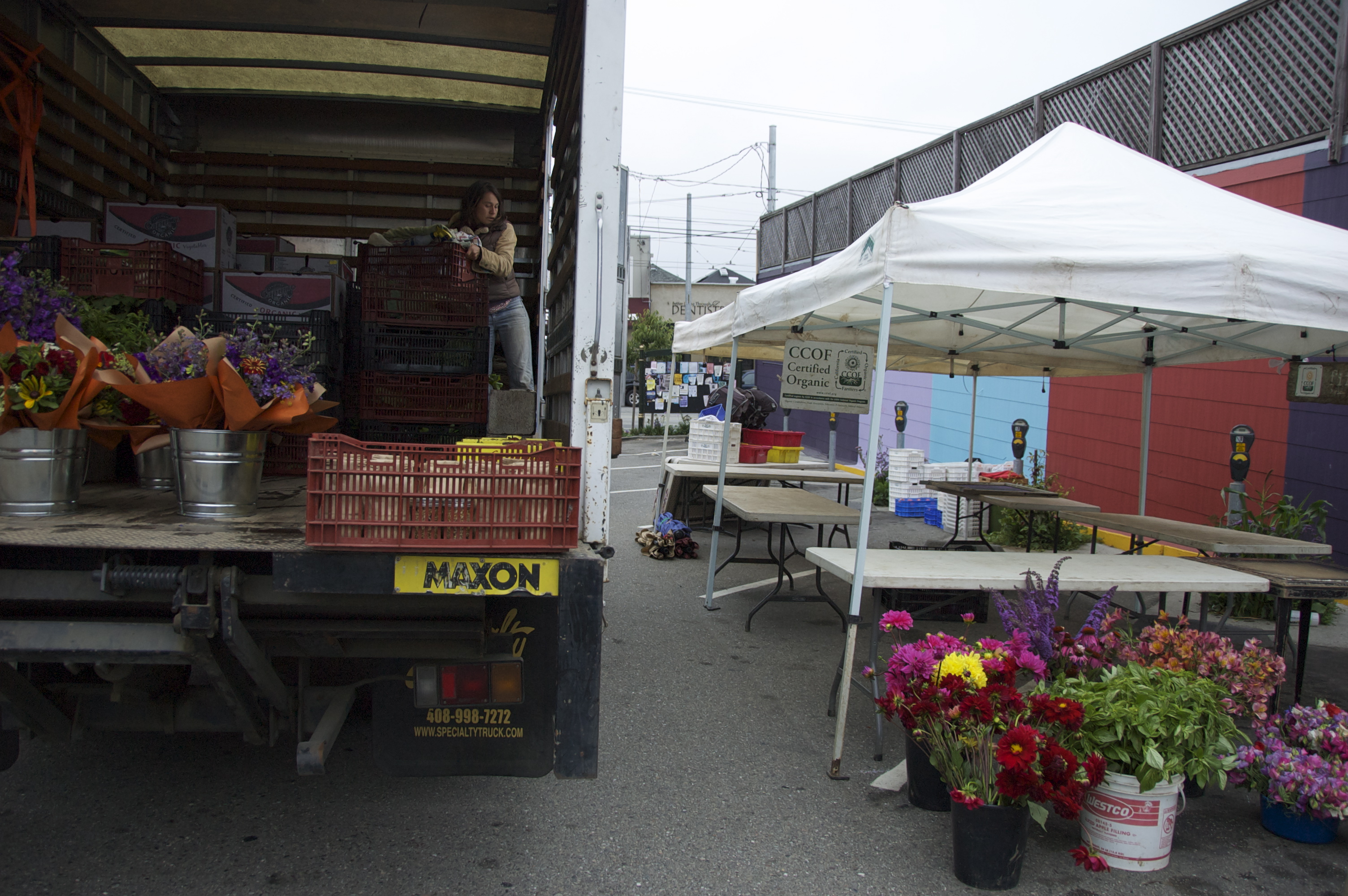
6:10: We’re the first ones to arrive at the site of the Inner Sunset Farmers’ Market in San Francisco.  I try not to feel too guilty for taking photos instead of helping Teresa unload the truck and set up her stand…

7:00 am:  Teresa’s market helper, Anne, shows up and pitches in.

8 am:  After they’ve unloaded the truck, we repark it in Golden Gate Park, and go back to finish setting up Teresa’s stand.

8:15 am:  Robert MacKimmie of City Bees shows up and begins to set up his stand next to ours.  Robert has become a good friend of the farm and is Teresa’s regular post-market dinner date.  Today he’ll also be featured at the California Academy of Sciences’ first Local Bites event after the market.

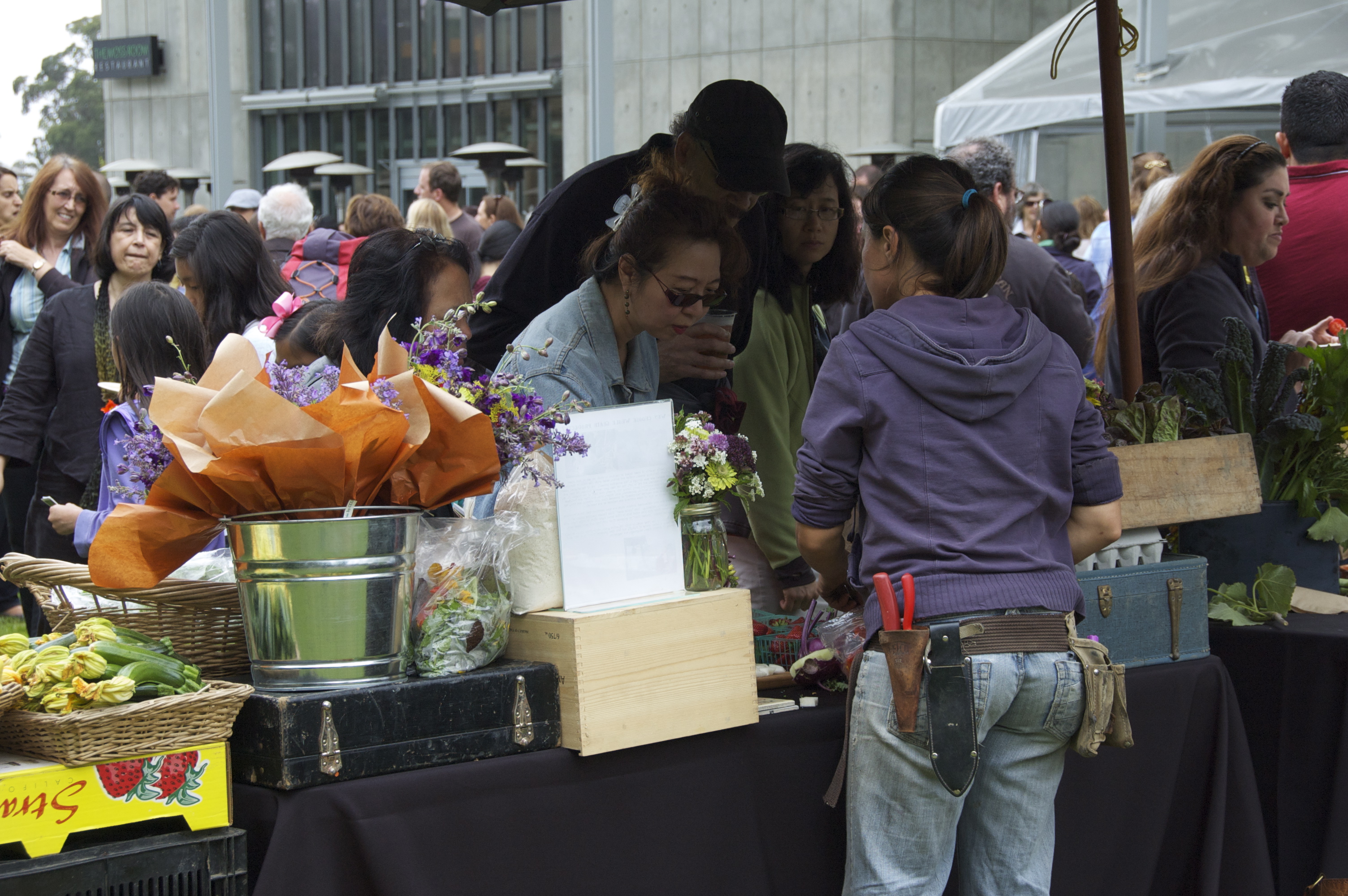
8:35 am.  I go across the street to Arizmendi Bakery to buy more coffee to help Teresa and Robert get through the morning rush.  By the time I get back the market is officially open for business and there’s already a long line at the 5th Crow stand.  Teresa spends the rest of the market lifting crates of produce and answering questions from the customers while Anne handles the money.


12:00 pm:  Two of Teresa’s dedicated regular customers show up to help out, giving Teresa and me a chance to get her strawberry samples out of the truck in Golden Gate Park and walk over to the California Academy of Sciences to get the lay of the land.

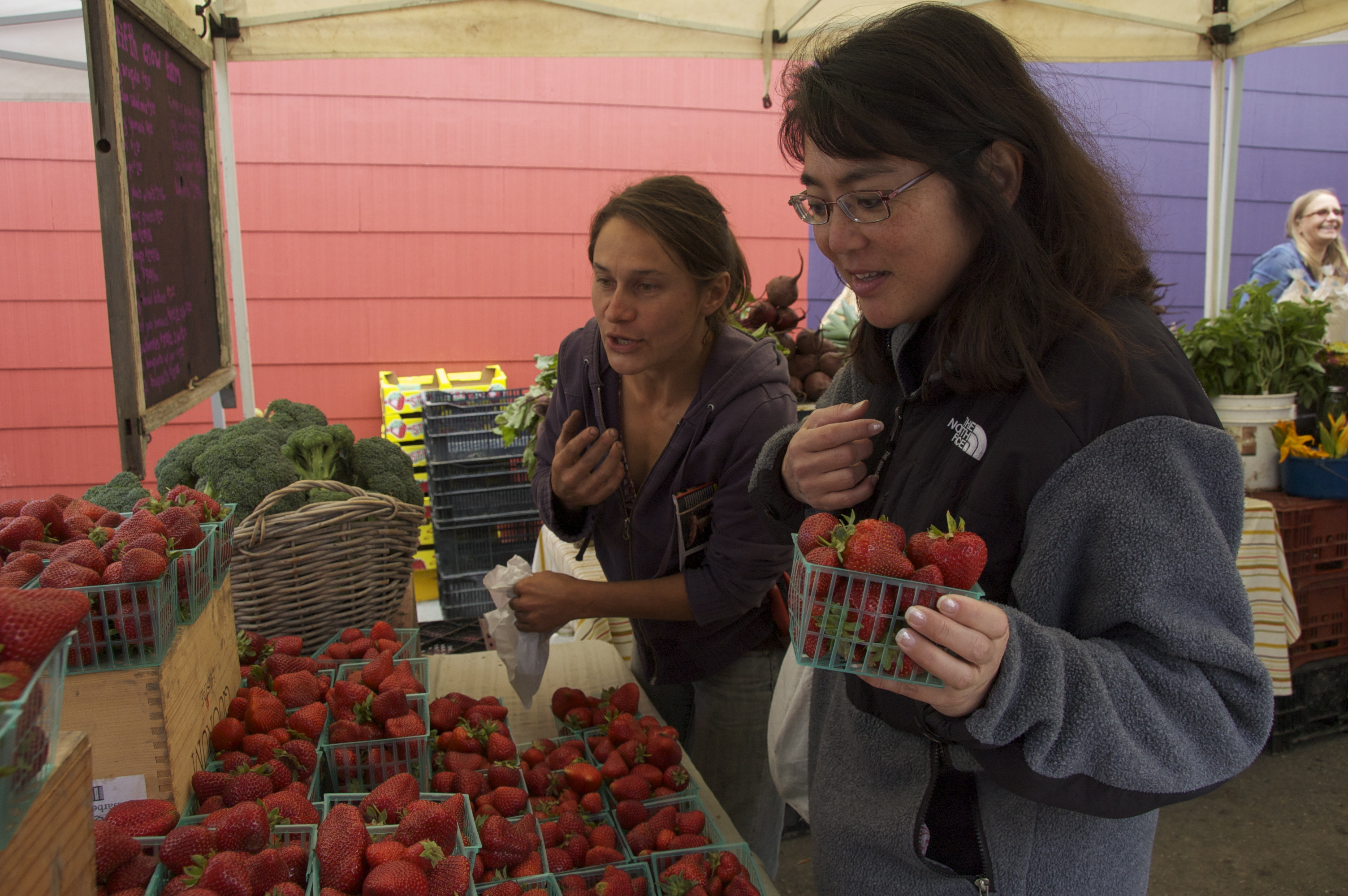
1:00: By the time we’re done at the Academy of Sciences, the market has officially closed so we pick up the truck and drive it back to the market to load.  Teresa, her helpers and Robert all pitch in to load the truck in a hurry.  We drive it over to the Academy of Sciences, unload onto small carts and wheel the goods into the event-space.  The vendors aren’t allowed to sell their products at the event, but Teresa brings some for display to give the guests a sense of what she grows.  We get there late and set up her table while the band plays and the guests are moving around tasting the samples.  Teresa gives out samples of strawberries, edible flowers and kholrabi, while continuing the lifting and talking that she’s been doing all day.

3:00: Bathroom breaks are hard to come by!

4:30:  The event winds down early and we start packing up the produce, loading it back onto the carts, and wheeling it out to the truck to reload.  

5:30 We take a break to stand around and talk with the helpers.  Then we drive the truck back to the market site, which is once more a parking lot, unload Robert’s stuff into his own car, and find a place to eat.  Teresa talks with her hands a lot.

6:15: Dinner! This is the first time Teresa has sat down since getting out of the truck at 6:10 in the morning.  Robert is still wearing his bee antennae  : )

7:30: We walk to a cafe to buy coffee to help Teresa stay awake on the drive home and get back on the road.

8:44: Dusk

9 pm:  We get back to the farm.  Teresa decides to postpone unloading the truck until tomorrow morning and I drive home.

******

To see more photos from my day with Teresa, click here.

Academics and the creative process

Mike commenting on a finished work.

This week I got a personal tour through New Mexico artist Mike Bell’s paintings. Now, artists and academics are usually depicted as two entirely different types of people.  Artists are free-thinking, soulful and sometimes a little wild, while academics are uber-rational eggheads who delight in flow-charts, facts and logic (right?!).

Nonetheless, I think academics have a lot to learn from artists.  We don’t usually talk about our work as a creative endeavor, but the process of shaping our own ideas, making unexpected connections between events and ideas, and writing about the social world involves a touch of mystery that artists seem much better equipped to think about than academics are.

The more I hear Mike and other writers, sculptors and creative types talk about their work process, the more I learn about my own.  We all need to find ways to keep our creative juices flowing in spite of other, often more pressing, demands on our time.  We struggle to value our ideas enough to try to realize them, to learn who is helpful to discuss early-stage ideas with and whose commentary will have toxic impacts on our work, to navigate the pressure to be our own best publicist with competing instincts to be humble.  Sometimes we think our creations are terrible as we are making them and then come back later and realize they aren’t half bad.

Beginning scholars in particular need all the help we can get in navigating the creative terrain of our work.  I’d love to find ways to bring us more formally into conversation with artists! In that spirit, please send in any of your own creative practices and tips!

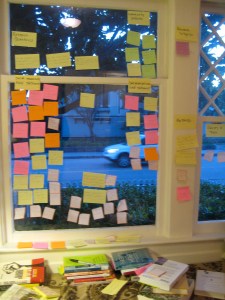
My creative process involves lots of post-its…

Dead Central

I’m not usually a fan of swapping “kids these days” stories about my students with other teachers.  To my mind college students are too old to be kids, so I usually just stick with calling them “students” instead.  Still, I had a classic “shake my head at kids these days” moment recently.  While we were chatting over the photo-copier, one of the staff-members in my department described a mysterious “dead room” in the newly renovated library.  Sure enough, when I went over to check out books later in the day it also caught my eye.  My conversation with the librarian about it went something like this:


Me, while checking out books:  The renovations to the library look great! But what on earth is “Dead Central?”

Librarian:  That’s where the Grateful Dead Archive will go.

Me:  Of course, awesome!

Librarian:  Lot’s of the students have never heard of them.

Me:  !!!!!!!


(On the other hand, earlier this year one of my students came across the job announcement for a “Grateful Dead Archivist” and pronounced it the coolest job ever…)

Write a literature review, practice innovation

Convincing students of the value of writing a literature review as part of a research proposal can be a hard sell. They must research a huge body of academic scholarship on their topic and adjust their own research question so that it meaningfully builds on what has already been done.  Especially for the many students not planning a career in academia, I think it can feel like an exercise they do just to satisfy the course requirements rather than because they think they’ll get much out of it.  We talk about it helping them develop their critical thinking skills, but I suspect that isn’t particularly motivating, since all their other classes and assignments are supposed to be doing the same thing.

However, the process of writing a literature review is also good practice in innovation.  Knowing what has already been done in your field makes it much more likely that you’ll be able to recognize and develop ideas that are unique and interesting, and learning this process is a valuable skill.  For example, I sometimes talk to students who want to create whole new organizations to address social problems they care about.  I usually encourage them to first research the existing organizations in that field and learn from what they’ve done before striking out on their own.  Nonprofits need to know what their partners and competitors are doing and be able to describe how their work is different to be able to find funding.  I imagine it is the same in other fields.  Businesses that offer new, useful products not offered elsewhere have an edge over other businesses.  Journalists who have found a new angle on an old problem are more likely to get published and read than those that write things similar to what has been written before.  Lawyers do a “document review” process to help them understand how similar cases have been litigated before putting together their own cases.

Drawing these parallels between the process of writing a literature review and shaping a research project around it and it’s equivalent in other fields could also lead to some interesting discussions about scholarship and innovation.  For example:

  • Is a new research project/product/organization always better than old one?
  • What are the similarities and differences between innovation in academia and in other fields?
  • Is innovation always rewarded?  What are its risks?
  • Can anyone innovate?
Certainly innovation isn’t all about hard work.  There’s a certain amount of luck and historical timing involved too.  But I suspect that broadening the discussion of writing a literature review to include similar tasks in other fields may make the process more concrete and valuable for students.

Action research syllabus collection

Although all academics hope their research makes an impact in the real world, some take extra steps to make that outcome more likely.  This small but vibrant sector of academia talks about their work with terms like action research, participatory action research, public sociology, engaged scholarship, activist scholarship, applied research and more. I’ve recently acquired three fascinating syllabi in this genre and added them to my collection.  Two are intended for graduate students and one for undergrads.

I must say blogging is a great way to share my various little treasure chests of these sorts of things.  I hope you enjoy them too!

This collection also has a permanent home under the “Teaching” tab on the menu at the top of this site.

Blogging in the classroom

I’ve always been interested in learning about ways that teachers link what they do in the undergraduate classroom to real world events.  I’ve seen this include asking students to bring in news clippings that relate to the course content, developing collaborative research assignments on new local city policies that are then presented back to the public, archival work, creating and testing environmental education curricula for partnering community organizations, and a variety of other service-learning projects.

So I was very interested today to see the results of a public sociology course taught by my colleague Prof. Alison Alkon at the University of the Pacific.  Over the course of a semester Alison trains her students to identify sociological concepts in the media, find press coverage of current events that lacks a sociological perspective but could benefit from its inclusion, and then create a media piece that uses sociology to help explore an issue of their choice.  The class projects have resulted in the following two blog posts:

Creating writing assignments that students can later submit to a blog of their choice seems like a great way to engage them in issues they are passionate about, with the extra motivation that comes from writing something that could be read by people other than their teacher (both posts generated spirited debates in the comments sections that follow them).   I hope Alison will keep us informed as more of her students get published!

More blogging ideas:  See sample assignment ideas for working with the Sociological Images blog here.  See Alison’s public sociology syllabus here.  See the website of a professor whose students write guest-posts on his own blog here.

Spanish language teaching tools for environmental justice

Yesterday one of the excellent tech masters at UC Davis uploaded the most recent addition to the 25 Stories from the Central Valley website: Teaching tools in Spanish (click the ‘en español’ icon in the upper right corner if the link pulls up the English version).  The tools were designed to help college-level teachers introduce basic environmental justice concepts in the classroom, but I imagine some of them could be adapted to work in other settings as well.  Three of the tools depend on English-language documents and data available online, but I decided to include them also in the hopes that others might know of Spanish-language equivalents to use.  Enjoy!

Thank you to Mateo and Roy at Berkeley Interpreting, Transcription and Translation Services for doing the translation, to Silver Cruz for updating the website, to Ed Reed at the UC Davis John Muir Institute of the Environment for getting it online, and to the UC Humanities Research Institute for paying for it!