Visions of the San Joaquin Valley

I spent time yesterday looking at Barron Bixler’s photographs of agriculture in the San Joaquin Valley.  He’s arranged his photos into a beautiful slideshow set to music called A New Pastoral: Views of the San Joaquin Valley.  I’ve formed my own vision of the San Joaquin Valley over the last few years, and it’s fascinating to see how someone else views and presents the region.  Some of Bixler’s photos depict scences familiar to me – stark  landscapes of row-crops, orchards with factories in the background, agricultural machinery, railroads and storage facilities.  I loved seeing these familiar places through his eye. Others show places I’ve never been, like the inside of an industrial milking facility.

Bixler’s photos are entirely devoid of people – they depict industrial agriculture through the landscape and built environment it creates.  Matt Black’s photos, on the other hand, center on the immigrants and farmworkers living and working in the San Joaquin Valley.  They are entirely human. I enjoyed checking his captions to see if the small towns he has depicted were places I’ve spent time in too (mostly not).  He has also created a powerful digital project about the birth defects in Kettleman City.

David Bacon’s work doesn’t focus on the San Joaquin Valley per se, but he has a number of photo collections of farmworkers, immigrants, and UFW advocacy set there.  See his work here and here.

Finally, Ken Light’s new photographic book, Valley of Shadows and Dreams, will be published soon by Heyday Press.  I saw some of his work on this project when I took his documentary photography class several years ago at UC Berkeley, and can’t wait to see the finished product.  Check out the photo on the book’s cover, it’s gorgeous.

And, here’s a link to my own humble efforts to photograph the San Joaquin Valley.  I try to show the grave environmental health problems facing this region, but also the hard work being done by its residents to change things. I also try to convey my sense of this under-appreciated part of our state as beautiful in its own right. An updated version of this collection will be online soon, as well as a nifty new collage that combines new photos with oral history.

Meet Greenaction’s newest board member… me!

Last week I was formally voted onto the board of directors at Greenaction for Health and Environmental Justice. I’ve been interested in board-memebership ever since I first started working in the non-profit sector, so I’m looking forward to this new role.  Greenaction is an environmental justice organization that works with poor communities and communities of color threatened by high pollution levels. I see them as a sort of “green” version of the Red Cross that works with communities in distress to help them get relief.

I first began working with Greenaction when I was conducting my master’s research at UC Davis.  I approached Greenaction’s executive director, Bradley Angel, as well as leaders at a number of other organizations active in the Central Valley, to pitch them my research project and ask for help finding people to interview.  Bradley became a member of the advisory committee that later helped me develop the 25 Stories from the Central Valley project, and we’ve stayed in touch since.

My new role on the Greenaction board will provide interesting new opportunities and challenges.  The risk for scholars who are actively involved with the populations that they research is that they might find it difficult to step outside the group’s dominant views on their research topic to pursue their own analysis.  On the other hand, more intimate involvement often provides researchers access and insight into their research topic at a level that far exceeds what is available to more distant observers.  So far I’ve felt that the benefits outweigh the risks in my own work.  I’ve been explicit with my new colleagues that the opinions I express in my writing may not always agree with their own.  Certainly activists groups are very familiar with internal disagreement, so in a way this is nothing new.  Still, UCSC Prof. Flora Lu and I are the first scholars to ever sit on Greenaction’s board, so we’ll be taking things one step at a time.

Greenaction just celebrated their 15 year anniversary, and I’m looking forward to learning more about the rich history of West Coast environmental justice activism of which they’ve been an integral part. I’m also excited about this opportunity to give back to the community that has shared their lives and stories so generously with me.

Greenaction board members, staff and friends. Dec. 9, 2011.

Teaching classical sociological theory through the media

Each quarter I try structuring my classes differently so that I can experiment with a variety of teaching styles. This quarter I worked as a teaching assistant for my department’s “Classical Sociological Theory” class, which covers changes in European and U.S society that occurred during and after the Industrial Revolution.  I required each student to sign up for one week in which to turn in a relevant media piece and an accompanying one-page essay.  Here are the instructions I gave them:

Each of you are responsible for finding a news article, short video, cartoon, photo collection or other piece of media relevant to our readings once during the quarter. Your assignment is to select a media piece (10 min. max) that will help the rest of the students relate what we are reading about to current events, or help them understand one of the week’s theories better in its historical context.  E-mail me a link to this item the Friday before discussion section, along with a one page type-written paper describing how you suggest using the item in class and what its strengths and limitations are for understanding the relevant theory. 

I really liked this assignment.  I designed it primarily to give me ideas to use as a starting place for what to do in class each week, but it has educational value for the students too.  Each week I had between 5-8 one-page papers to skim for ideas.  I didn’t always end up using something that the students suggested, but they always got my mind moving in the right direction.

Sometimes I organized the entire class around one or more media pieces, and other times they played much more marginal roles.  I used them in a variety of ways:

  • showed the media piece and asked the students to identify which theory it best illustrated
  • showed the media piece and asked the students what a particular theorist would think of the events depicted
  • prepared an ungraded quiz in which the students first watched a series of media clips, then individually responded to written questions that asked them to identify which theory the clips best illustrate
  • played the clips while the students came into class or while I took attendance to set the tone for class
  • showed clips to give students a sense of the historical context in which a particular theorist lived

When everything works well, the media pieces help make theory less abstract and more memorable, help students relate to theory by showing its relevance to current events, and test the boundaries of student understanding of theory by asking them to apply it in a new context and identify what parts of the theory fit and what don’t.

Next time I use this approach, I’d like to spend more time discussing the limitations of using the theory in question to interpret the media piece.  I expect this would help the students understand the theories in a more nuanced way, but I often ran out of time to do it.

Mini media library

Here are my favorite pieces. Some of these were submitted by students, some I found myself, and some are from other teaching assistants and faculty.  I did not use all of them in class.

Feudalism

Marx

Weber

Durkheim

  • Mechanical society: Baraka clip

The enlightenment and the counter-enlightenment

Foucault

Participatory action research for environmental justice

The UC Davis Center for Regional Change launched their newest report yesterday: Land of Risk/ Land of Opportunity: Cumulative Environmental Vulnerability in California’s San Joaquin Valley. The report documents how exposure to environmental pollution tends to go hand and hand with social vulnerability, creates maps that visually depict this relationship, and provides several case-studies.

This report was created by the authors with partners from the San Joaquin Valley through the San Joaquin Valley Cumulative Health Impacts Project.  I attended one or two of the group’s earliest meetings several years ago and have tracked their progress through conversations with the lead author (my former advisor Jonathan London) and the environmental justice advocates that are part of my own research.  I also donated a few of my photographs for use in the final report.

When I give guest-lectures on divisions between campus-community divides, I often use this project as an example of ways that scholars and activists can work together productively.  In particular, I find it helpful to show students the detailed agreements that the group worked out ahead of time to guide their collaboration.  Because the work of scholars and activists are judged in different ways, these kinds of guidelines can go a long way toward anticipating and resolving the tensions that often come up.  You can see their agreements (shared with the lead author’s permission), in this post.

On the limitations of knowledge

I turned in my first federal grant application today, and just wading through the endless instructions felt like a real accomplishment! This particular grant asked me to provide the ‘expected answers’ to my research questions.  Given that I haven’t actually started the research yet, this felt a bit like putting the cart before the horse.  But hypothesis testing, as it is called, is one standard approach to social science research.  It wouldn’t be very convincing to the granting agency, but I was tempted to include this poem in my application:

Be patient toward all that is unsolved in your heart
and try to love the questions themselves.
Do not seek the answers, which cannot be give you
because you would not be able to live them.
And the point is to live everything –
Live the questions now.
Perhaps you will… gradually,
without noticing it, live along some distant day into the answer.

– Rainer Maria Rilke

Day at the newest UC

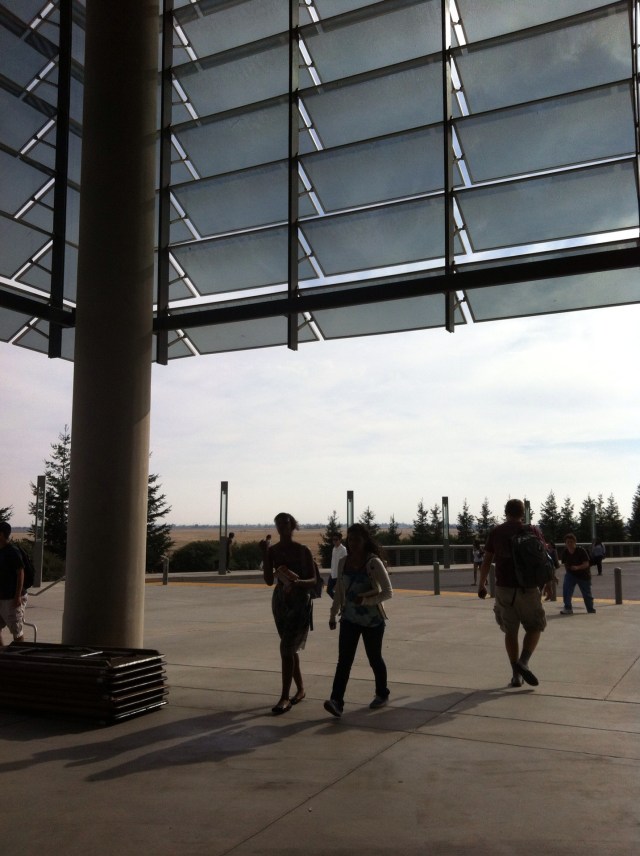
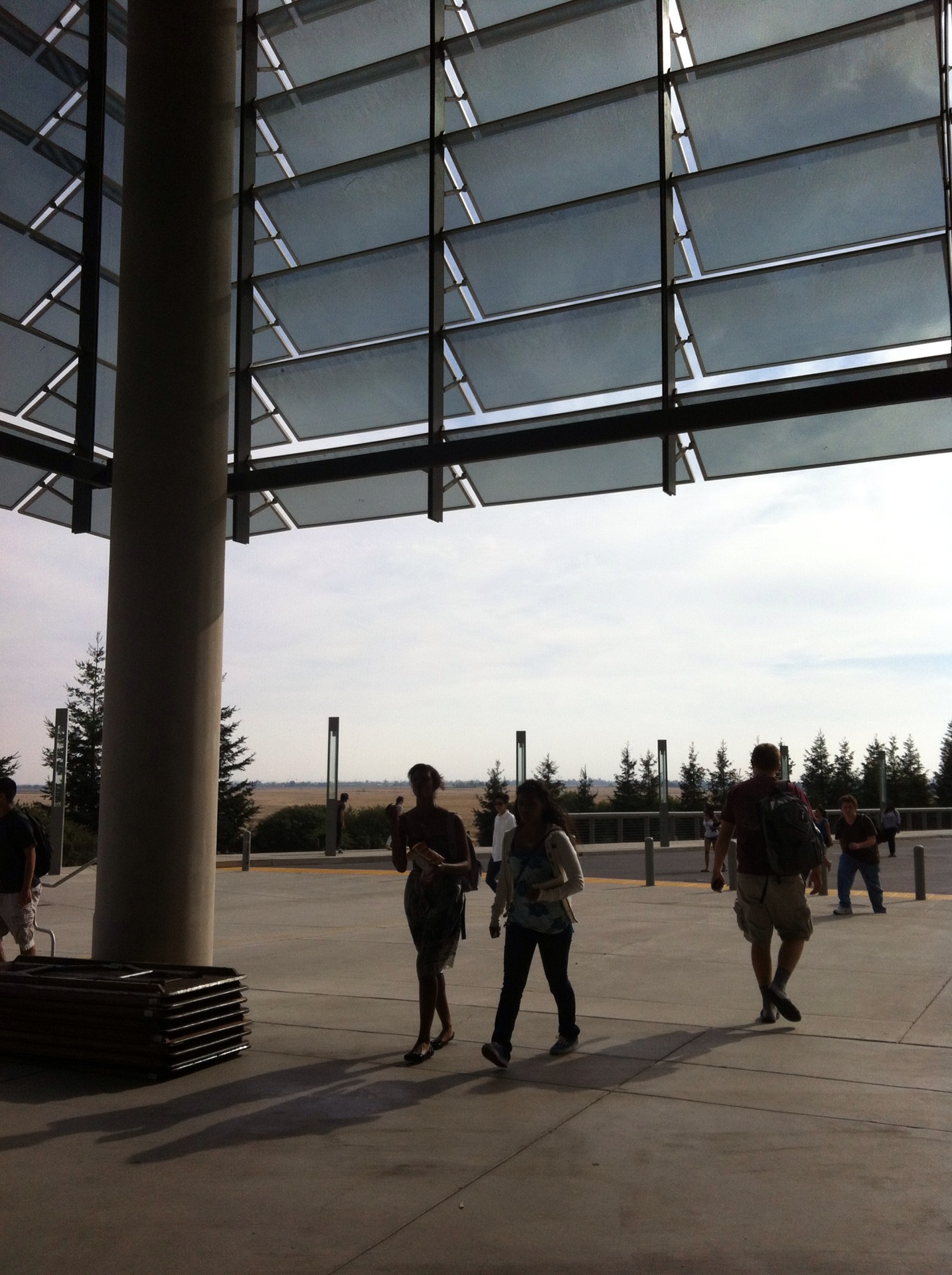
I spent yesterday visiting UC Merced – the state’s newest University of California campus, and the first in the San Joaquin Valley.  It’s small but quite impressive!  They have about 5,000 students, mostly undergraduates, and will grow into a larger university over time.  Here are a few shots of their modern buildings and grounds.  (The buildings are all LEED certified.  Check out the reflective panes attached to the walls of the library to reduce cooling costs, and the gravel parking spots that reduce runoff.)


Ode to my web designer(s)

One of the really fun parts of my work over the last few years has been getting to work with web designers to build the 25 Stories from the Central Valley website.  In 2008, Derek Hunziker from the John Muir Institute for the Environment at UC Davis built the current site, and over the last few months I’ve been working with his replacement Tyler LaGue to add more content and revamp the site’s look and organization.

Derek built me a beautiful site that I loved.  I had a blast dreaming up ideas and seeing him bring them to life, only better.  The only problem was that it was really hard to update.  When we launched the site, clicking on one of the key menu items brought up the optimistic message “Coming soon!”  Three years later, the message still hasn’t changed.  : (

In the meantime, I met Aspiration’s tech guru Allen Gunn at the Greenaction holiday party last year.  He immediately diagnosed the problem as having created a custom-built website that locks me into relying on a programmer to make changes instead of a pre-fab one designed for people like me to be able to manage.  That meant that any small correction or addition I wanted to make had to wait to be addressed until I could fundraise more money to hire another programmer to make the changes.  That conversation launched my experiment with WordPress and this blog.  I had a great time browsing among the many looks available and and setting it up to appeal to my aesthetics.  It’s a much more whimsical, personal site than the 25 Stories site, and the look reflects that.

Now, Tyler is rebuilding the 25 Stories website to reflect the best of both worlds.  It’s a WordPress site that I’ll be able to update on my own, but he is using his programming magic to make it do more than I could.  We’ll finally do away with the “Coming soon!” message and replace it with an interactive collage  that features excerpts from my interviews with women environmental justice leaders of the San Joaquin Valley.  We’ll also have a slide show of the project’s playback theater performances by Kairos Theater Ensemble, and a media feed that collects and archives coverage of San Joaquin Valley environmental justice advocacy.

The whole process has been a blast, and a great way to balance out the other kinds of work I do.  I get to dream up what I want, bounce ideas around with Tyler, and then see how he magics them into existence. It’s richly creative and entirely satisfying.  Plus, how many times in your life do you get to hear someone say, “Whatever you want, we can make it happen.” ?!?  Stay tuned for the final product!

Blast from the past

My friend Matt and I happened onto a vintage European poster store in Berkeley last week and had a great time looking through their collection.  All the posters were originals, and some had been made as long ago as the 1890’s.  Matt was interested in the war propaganda posters, but I found myself drawn to posters that inadvertently advertised the social problems of their time:

On racial stereotyping (right-hand poster):

On efforts to quell labor disputes – bottom right.  The scenery features a rainbow landing in a bucolic alpine valley  (“Let’s Clear the Air. Let’s iron out the trouble. You’ll feel better, work better, get farther.  You’ll be treated fairly.”) How creepy would this be to have hanging over your desk?

On the stigmatization of sexually transmitted infections:

On women’s subordinate status in the working world (“There’s a Man-Size Job For You in Your Navy”):

Part of what makes these old-time posters so great to look at is that the social messages embedded in them are clearer now than they would have been to most people at the time they were made.  Are today’s advertisements any less explicit?  In some cases yes, in others, no, but I imagine they are generally harder for people to decode because they are so much a part of our everyday life.