I’ve been working on the Ward Valley Archive since 2015. At that time I was in my final year of my PhD program at UC Santa Cruz, and was on the board of directors at Greenaction for Health and Environmental Justice. Greenaction Executive Director and co-founder Bradley Angel was working on cleaning up his archive of his involvement in the fight to prevent the construction of a nuclear wast landfill in the Mojave Desert’s Ward Valley during the 1990s.
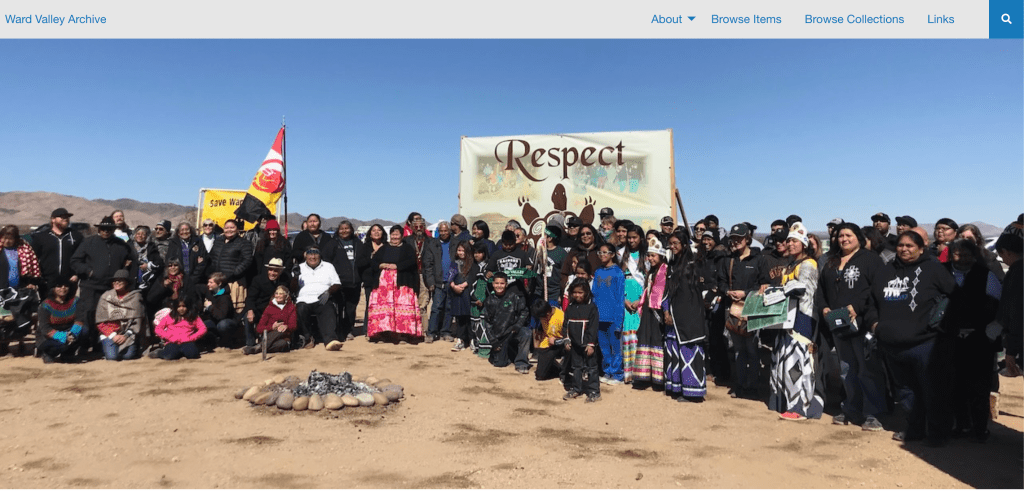
The fight to save Ward Valley drew in many people. The Indigenous peoples of the Lower Colorado River who have long lived on and near the proposed nuclear waste site opposed the landfill’s creation through their respective governments at the Fort Mojave Indian Tribe, Chemehuevi Indian Tribe, Colorado River Indian Tribes (CRIT), Cocopah Indian Tribe and the Fort Yuma Quechan Indian Tribe. They were joined by other Indigenous people from the southwest such as Corbin Harney and the American Indian Movement (AIM), as well as radical environmental and anti-nuclear groups including Greenpeace, Bay Area Nuclear Waste Coalition (BAN Waste), the Abalone Alliance and more. The campaign involved local, national and international organizing, policy advocacy, lawsuits, cultural practices, and a long occupation of the federally owned land where the site was to be built. The multiracial, multicultural occupation extended the practice of Indigenous land occupations of the 1960s and 1970s, the most high profile of which included occupations of Alcatraz and Wounded Knee, while also connecting to the largely white-led tree-sits of Redwood Summer in Northern California.
In 2014, UCSC professor and fellow board member Flora Lu oversaw a handful of students’ work on getting the papers organized and beginning a campaign timeline as part of a class project. I then kept the project going with other undergraduate students in 2015. Many years later, the project has expanded in collaboration with campaign participant and former tribal chair Nora McDowell of the Fort Mojave Indian Tribe. Bradley Angel’s original files have all been digitized and the physical copies donated to the Fort Mojave Indian Tribe. Other campaign participants have also since donated their files for digitization and inclusion in the archive – some of these are still in the process of being uploaded.
Check out the digital archive for a list of the many people who have contributed to its develop. More content will be added in future years. I conducted oral history interviews with campaign participants that will eventually be uploaded to the digital archive after they have been sufficiently reviewed and lightly edited for public use. I’ve also put together an exhibit that combines my own photography with select photographs and documents, and have been updating the campaign timeline begun by UCSC undergraduates.
Related blog posts:
- Avi Kwa Ame National Monument and the Ward Valley Archive
- The Ward Valley Nuclear Waste Dump That Never Was
- Nora McDowell speaking about women’s environmental leadership at the Smithsonian Castle
 Tracy Perkins