I took photos of the olive harvest outside of Exeter yesterday morning with Juan Gomez and his crew:
Category Archives: Agriculture
24 hours with 5th Crow Farm
When I moved to Santa Cruz one of the first friends I made was a woman named Teresa Kurtak. Teresa and her business partners Mike Irving and John Vars were looking for land to lease so they could start a small organic farm. They found what they were looking for in Pescadero, and are now in their third growing season there.
Most of the photos I see of small-scale organic farms present them as rural idylls – beautiful, bucolic, peaceful. My experience watching 5th Crow Farm grow is that organic farms may be beautiful but usually entail working long, hectic days. My urban lifestyle is probably a lot more peaceful! Certainly that’s what I thought after tagging along with Teresa while she worked this weekend. Here are some of my photos and a blow-by-blow account of what we did…
****
8:30 pm, Saturday night: I stop at the grocery store on my way to the farm to buy dinner for Teresa and Mike. They’ve been harvesting for the Sunday farmers’ markets all day and haven’t had time to think about dinner yet.
9:15 pm: I arrive at Mike and Teresa’s yurt on the farm.
9:30 pm: Teresa and Mike have dinner, and then Teresa starts to prepare the printed materials she needs for the next day’s special event at the California Academy of Sciences.

10:00 pm: The printer isn’t working so Teresa heads out to find a working printer elsewhere. I go to bed.
Midnight: Teresa goes to bed.
3:16 am, Sunday morning: Roosters start crowing. : (
4:30 am: Alarm goes off. : (
4:45 am: Teresa and I get in the market truck, which they loaded yesterday, and hit the road.

5:30 am: We stop to pick up coffee to help keep us awake on the road. I also buy a pastry for my breakfast.
5:43 am: Dawn.
6:10: We’re the first ones to arrive at the site of the Inner Sunset Farmers’ Market in San Francisco. I try not to feel too guilty for taking photos instead of helping Teresa unload the truck and set up her stand…

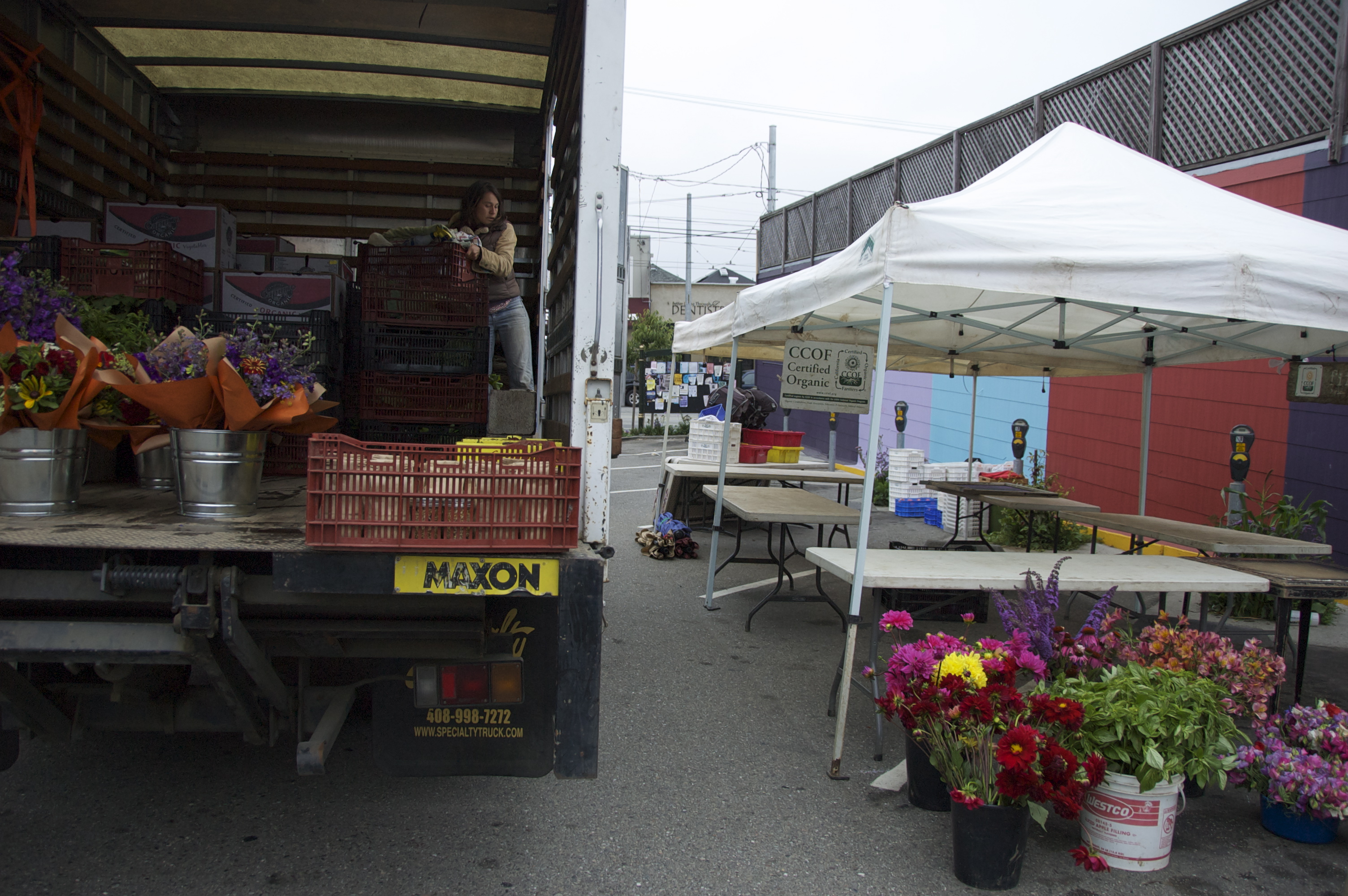
7:00 am: Teresa’s market helper, Anne, shows up and pitches in.
8 am: After they’ve unloaded the truck, we repark it in Golden Gate Park, and go back to finish setting up Teresa’s stand.
8:15 am: Robert MacKimmie of City Bees shows up and begins to set up his stand next to ours. Robert has become a good friend of the farm and is Teresa’s regular post-market dinner date. Today he’ll also be featured at the California Academy of Sciences’ first Local Bites event after the market.
8:35 am. I go across the street to Arizmendi Bakery to buy more coffee to help Teresa and Robert get through the morning rush. By the time I get back the market is officially open for business and there’s already a long line at the 5th Crow stand. Teresa spends the rest of the market lifting crates of produce and answering questions from the customers while Anne handles the money.

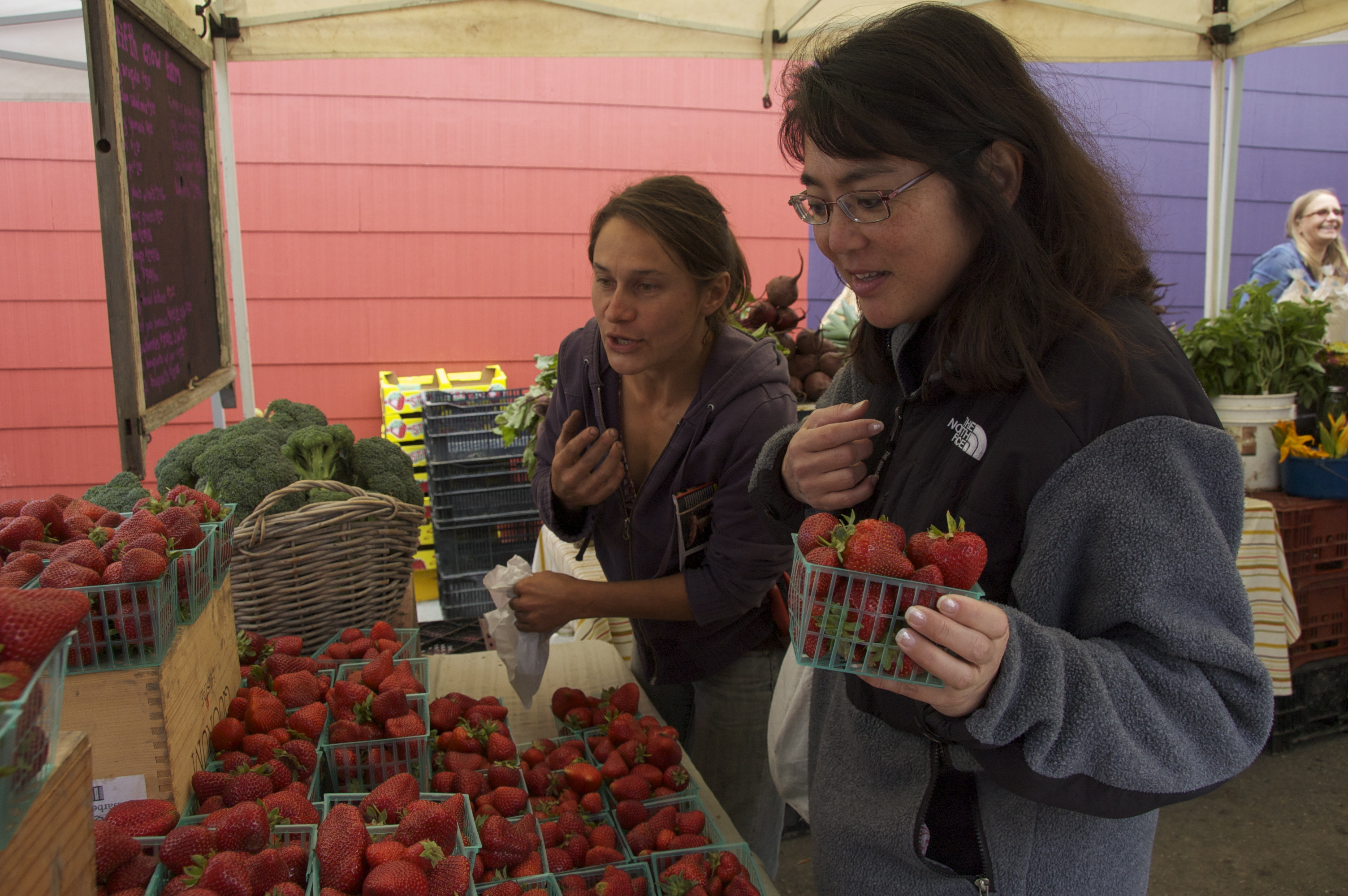

12:00 pm: Two of Teresa’s dedicated regular customers show up to help out, giving Teresa and me a chance to get her strawberry samples out of the truck in Golden Gate Park and walk over to the California Academy of Sciences to get the lay of the land.


1:00: By the time we’re done at the Academy of Sciences, the market has officially closed so we pick up the truck and drive it back to the market to load. Teresa, her helpers and Robert all pitch in to load the truck in a hurry. We drive it over to the Academy of Sciences, unload onto small carts and wheel the goods into the event-space. The vendors aren’t allowed to sell their products at the event, but Teresa brings some for display to give the guests a sense of what she grows. We get there late and set up her table while the band plays and the guests are moving around tasting the samples. Teresa gives out samples of strawberries, edible flowers and kholrabi, while continuing the lifting and talking that she’s been doing all day.
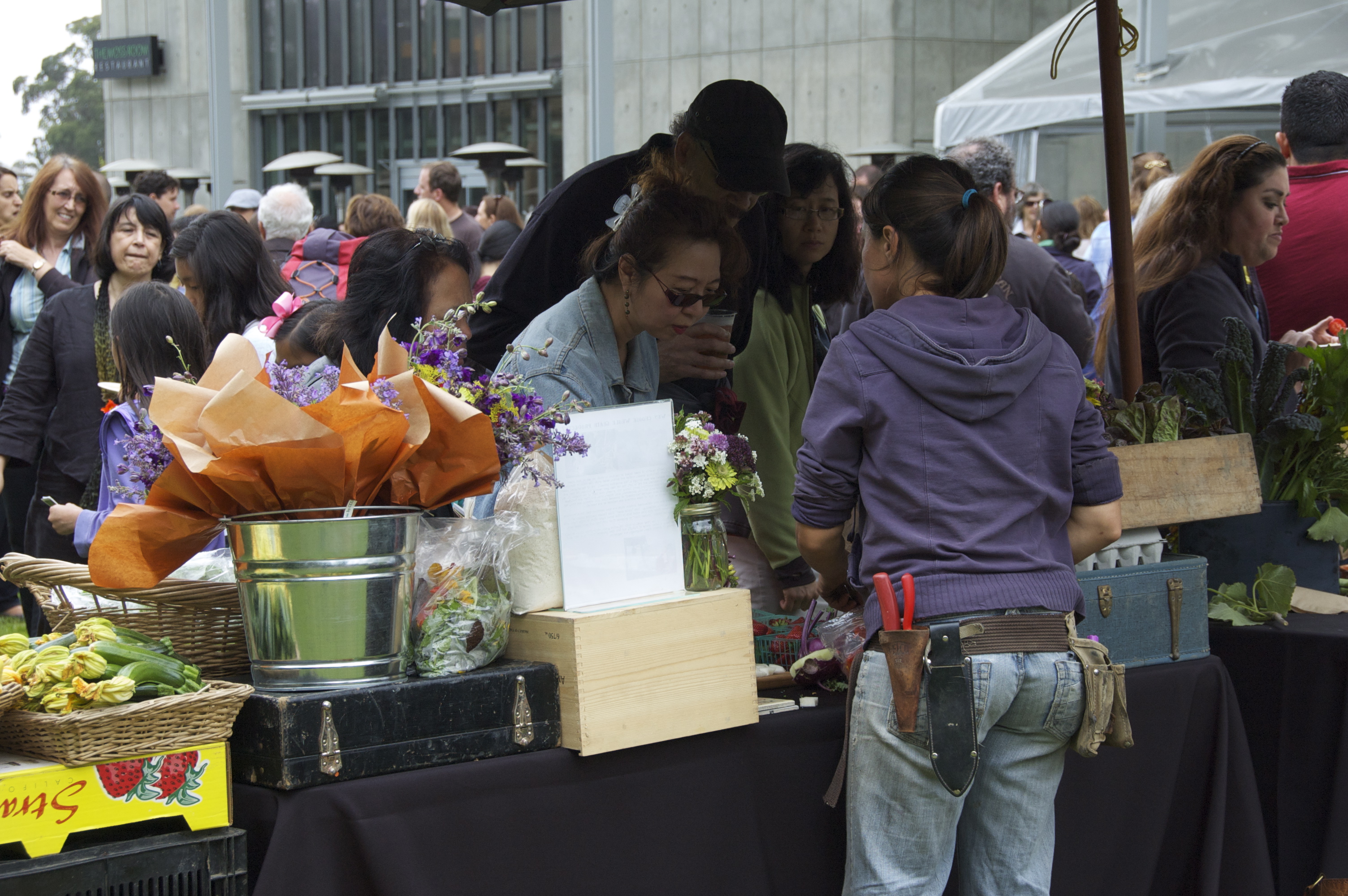
3:00: Bathroom breaks are hard to come by!

4:30: The event winds down early and we start packing up the produce, loading it back onto the carts, and wheeling it out to the truck to reload. 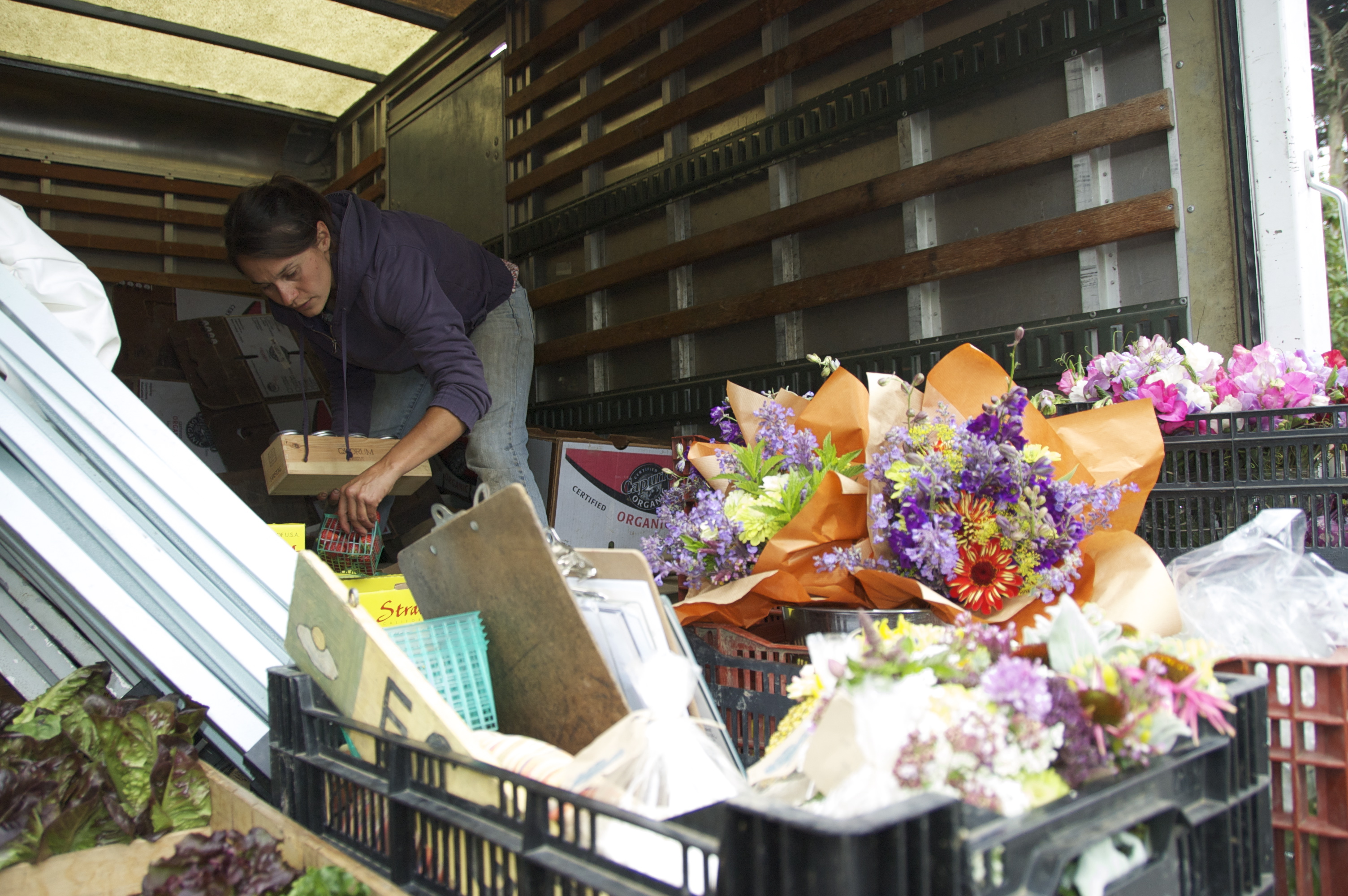
5:30 We take a break to stand around and talk with the helpers. Then we drive the truck back to the market site, which is once more a parking lot, unload Robert’s stuff into his own car, and find a place to eat. Teresa talks with her hands a lot.
6:15: Dinner! This is the first time Teresa has sat down since getting out of the truck at 6:10 in the morning. Robert is still wearing his bee antennae : )

7:30: We walk to a cafe to buy coffee to help Teresa stay awake on the drive home and get back on the road.

8:44: Dusk
9 pm: We get back to the farm. Teresa decides to postpone unloading the truck until tomorrow morning and I drive home.

******
To see more photos from my day with Teresa, click here.
Water wars in the Central Valley
In my work in the Central Valley, I’ve focused more on problems with drinking water, which comes from groundwater, than I have on water for agriculture, which comes from highly contested surface water. Nonetheless, in my travels I see many signs of struggle over agricultural water allotments. “Congress-created dustbowl” signs appear on land next to the freeway and in some rest-stops trucks have been turned into giant political water posters.
 So I enjoyed reading Matt Black’s article about recent agricultural water restrictions over my morning tea today. He speaks to the way water allotments are a zero sum game in our state: cuts for agriculture take farmland out of production in favor of preserving healthy riverine ecosystems further upstream and vice versa. Mostly, Black focuses on the impact of the agricultural cuts on the poor who live precariously on the fringes of the agricultural economy. This paragraph was particularly eloquent:
“As I watch this ersatz abundance turn to dust, I’m left conflicted. When a group of farmers and politicians pose for news cameras in front of destitute housewives in a bread line, it feels outrageous. Don’t they know that families here have relied on food handouts for years? Are they really using their workers’ poverty – a poverty born of decades of exploitative wages – to get more subsidized water?”
I was also pleased to recognize one of the photos in this essay as the cover photo of the inaugural edition of Boom: A Journal of California, which I also published a piece in. You can see more of Black’s photos on his personal website.
Foodies and farmworkers unite!
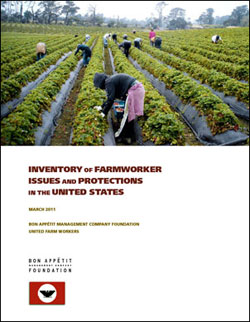 I was pleased to find this report in my virtual in-box this week:
Inventory of Farmworker Issues and Protections in the United States, by Bon Appetit Management Company Foundation and the United Farm Workers of America, March 2011.
It’s great to see farmworker issues getting some attention, but what really caught my eye was the fact that a foodie group and a farmworker group had co-authored the report together.
After spending years incrementally improving the environmental impacts and profitability of food production through organic agriculture and other labeling systems, foodies have become increasingly interested in improving the social conditions of food production too. While this conversation has most often centered around how to make improvements in working conditions on organic farms, this new report takes a much broader view. It analyzes working conditions for farmworkers nation-wide, as well as the scanty legal protections available to them.
One of the current debates in foodie circles centers on the pros and cons of trying to solve our food system’s problems with market-based tools: organic certification, fair-trade certification, buying local, etc. Should we rely on voluntary improvements by individual farmers who can then charge more for their products to consumers willing and able to spend more? Or should we focus instead on legislative solutions that require improvements by all farmers? While foodies have mostly used market-based solutions in their work, farmworkers groups have focused largely on legislative solutions.
My reading of the report suggests that its authors are pursuing a middle path. They hope that increasing the visibility of farmworker problems in this country will also increase consumer interest in purchasing food that is grown under safe, dignified working conditions. Then, more farmers will want to participate in labeling programs that require improvements in working conditions. These increasingly popular labeling programs will then help generate more interest in and awareness about the problems facing farmworkers, helping legislative solutions become politically feasible. I’ll be watching to see where this foodie/farmworker partnership will lead.
Here’s a few other items of interest that passed through my in-box last week:
- Bill would make it easier for California farmworkers to unionize Los Angeles Times, April 1
- Farm Exports and Farm Labor: Would a Raise for Fruit and Vegetable Workers Diminish the Competitiveness of US Agriculture? by Philip Martin, Economic Policy Institute Briefing Paper, March 21
 Tracy Perkins